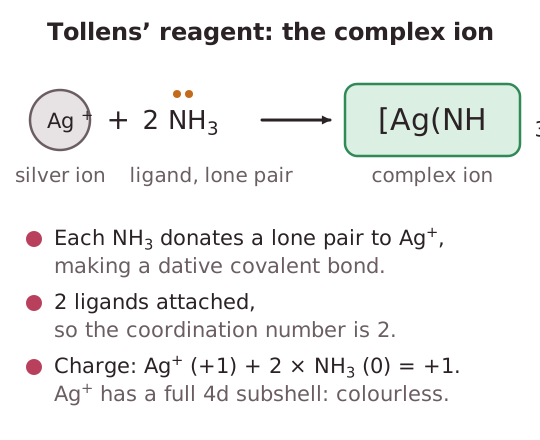
Silver is most commonly found in the +1 oxidation state and is easily reduced to silver metal.Ag+(aq) + e- → Ag(s) standard electrode potential +0.80VThis reaction is used to distinguish between aldehydes and ketones. Ammonia solution is added to silver nitrate to form the colourless complex [Ag(NH3)2]+. When added to aldehydes in the presence of OH- ions it reacts to give silver metal.RCHO(aq) + 2[Ag(NH3)2]+ (aq) + 3OH- → RCOO- + 2Ag + 4NH3 + 2H2O
Tollens Reagent
Read the text
Read the text and highlight anything you think is important. When you go on, the text is hidden and you answer from memory.
Specification: OCR Chemistry A (H432), A-level, 5.3.1 Transition elements and 5.3.2 Qualitative analysis. Topic: Transition Metals.
Key terms in this lesson
- standard electrode potential
- The e.m.f. of a half cell compared with a standard hydrogen half cell, measured under standard conditions.
More in Transition Metals
- Formation of Coloured Ions
- Spectroscopy
- Ligand Substitution Reactions
- Vanadium
- Redox Potential
- Redox Titrations
- Heterogeneous Catalysts
- Homogeneous Catalysts
All 21 lessons in Transition Metals · All OCR A-level Chemistry topics