Ammonia can act as both a ligand and a base. In dilute ammonia solution, ammonia acts as a source of OH- ions and transition metal ions react to form coloured precipitates as hydrolysis reactions occur. When an excess of ammonia is added ligand substitution takes place.If a small amount of dilute ammonia solution is added to a solution of hexaaquacopper (II) ions, a pale blue precipitate forms. On addition of excess aqueous ammonia the pale blue precipitate dissolves and the solution changes to a deep blue solution as four of the water ligands are replaced by four ammonia ligands. The product is a distorted octahedral complex as the copper-oxygen bonds are longer than the copper-nitrogen bonds. On addition of excess ammonia the Fe2+ and Fe3+ precipitates formed do not dissolve.
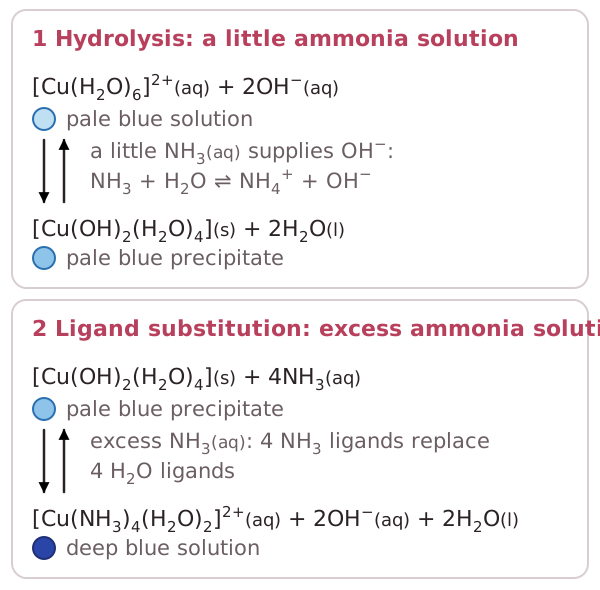
Reaction with Ammonia Solution
Read the text
Read the text and highlight anything you think is important. When you go on, the text is hidden and you answer from memory.
Specification: OCR Chemistry A (H432), A-level, 5.3.1 Transition elements. Topic: Transition Metals.
Key terms in this lesson
- ligand substitution
- A reversible reaction in which one ligand in a complex ion is replaced by another.
- octahedral complex
- A complex ion with a co-ordination number of six, in which the ligands are arranged symmetrically around the central metal ion.
More in Transition Metals
- Heterogeneous Catalysts
- Homogeneous Catalysts
- Autocatalysis
- Hydration of Metal Ions
- Reaction with Sodium Hydroxide
- Reaction with Sodium Carbonate
- Test for Transition Metal Ions
- Questions
All 21 lessons in Transition Metals · All OCR A-level Chemistry topics