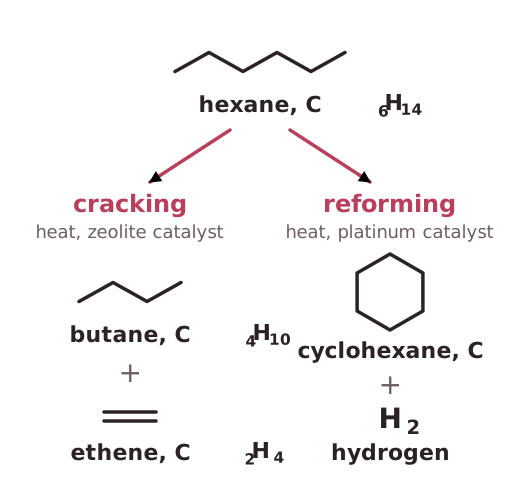
Shorter chain alkanes, branched and cyclic hydrocarbons are better fuels as they undergo more efficient combustion. Since the demand for short-chain, branched and cyclic hydrocarbons exceeds the supply whilst there is a surplus of longer, straight-chain hydrocarbons, longer-chain hydrocarbons are converted into shorter-chain hydrocarbons by thermal or catalytic cracking, and straight-chain hydrocarbons into branched or cyclic hydrocarbons by reforming.Cracking is done by passing alkanes over a heated zeolite catalyst made of aluminium, silicon and oxygen. Shorter chain alkanes and at least one alkene is formed.Reforming is done by heating alkanes with (usually) a platinum catalyst.