Transition elements have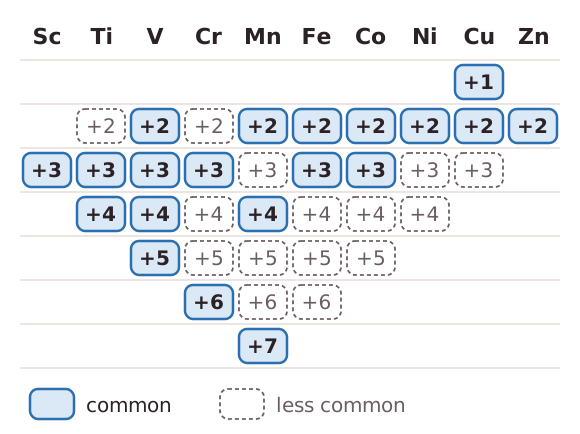 These properties come from the partly filled 3d subshell. The 4s and 3d energy levels are close together, so transition metals can lose different numbers of electrons and show variable oxidation states. For example, iron forms Fe2+ and Fe3+, and manganese shows every oxidation state from +2 to +7.Transition metal ions form complex ions because they are small, highly charged and have empty orbitals that can accept lone pairs of electrons from ligands. Their compounds are usually coloured because the ligands split the d orbitals, and electrons absorb some frequencies of visible light as they move between the split levels.Transition metals and their compounds make good catalysts because they can change oxidation state easily and can use their d orbitals to bond weakly to reactants on their surface. Examples are iron in the Haber process, nickel in the hydrogenation of vegetable oils to make margarine and vanadium(V) oxide in the Contact process.They have high melting points and densities because of strong metallic bonding: both the 4s and 3d electrons can be delocalised, so there are more delocalised electrons attracting the closely packed positive ions.
- Relatively high densities compared to group 1 and group 2 metals
- High melting and boiling points.
- Form complex ions.
- Form coloured ions.
- Good catalysts.
- Can have variable oxidation states.
These properties come from the partly filled 3d subshell. The 4s and 3d energy levels are close together, so transition metals can lose different numbers of electrons and show variable oxidation states. For example, iron forms Fe2+ and Fe3+, and manganese shows every oxidation state from +2 to +7.Transition metal ions form complex ions because they are small, highly charged and have empty orbitals that can accept lone pairs of electrons from ligands. Their compounds are usually coloured because the ligands split the d orbitals, and electrons absorb some frequencies of visible light as they move between the split levels.Transition metals and their compounds make good catalysts because they can change oxidation state easily and can use their d orbitals to bond weakly to reactants on their surface. Examples are iron in the Haber process, nickel in the hydrogenation of vegetable oils to make margarine and vanadium(V) oxide in the Contact process.They have high melting points and densities because of strong metallic bonding: both the 4s and 3d electrons can be delocalised, so there are more delocalised electrons attracting the closely packed positive ions.