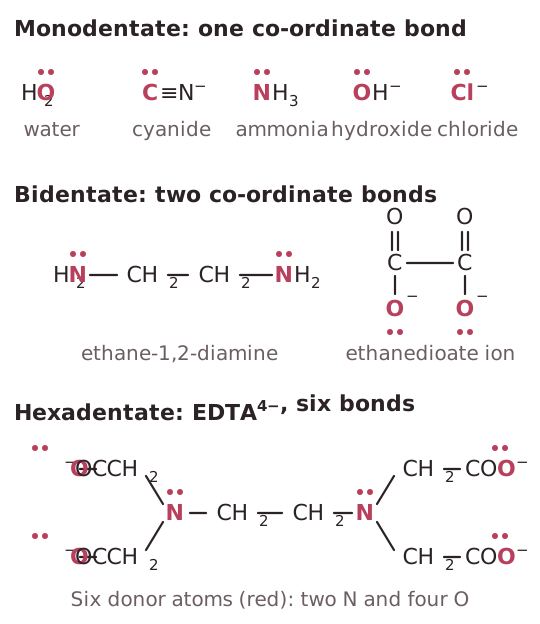
A complex ion is a metal ion surrounded by co-ordinately bonded ligands.A co-ordinate bond is a covalent bond formed when both electrons are supplied by one of the atoms involved in the bond. It is also called a dative covalent bond.A ligand is an atom, ion or molecule that donates a pair of electrons to a central metal ionMonodentate ligands can only form one co-ordinate bond. Examples are ammonia, chloride ions, hydroxide ions and water.Bidentate ligands such as ethane-1,2-diamine and ethanedioate can form two co-ordinate bonds. Hexadentate ligands such as EDTA4- form six co-ordinate bonds.