Recrystallisation is the standard way to purify an impure organic solid. It works because the product and the impurities have different solubilities in the chosen solvent.A suitable solvent dissolves the product well when hot but poorly when cold. Impurities should either be insoluble in the hot solvent or stay dissolved when it cools.The steps are:1. Dissolve the impure solid in the minimum volume of hot solvent, so the solution is saturated.
2. Filter the hot solution quickly through a warmed funnel to remove insoluble impurities. The funnel is warmed so the product does not crystallise in it.
3. Leave the filtrate to cool slowly. The solubility of the product falls and pure crystals form. Soluble impurities are present in small amounts, so they stay dissolved.
4. Collect the crystals by filtration under reduced pressure using a Buchner funnel.
5. Wash the crystals with a small amount of cold solvent to remove the solution left on their surface.
6. Dry the crystals, for example in a desiccator or a low-temperature oven.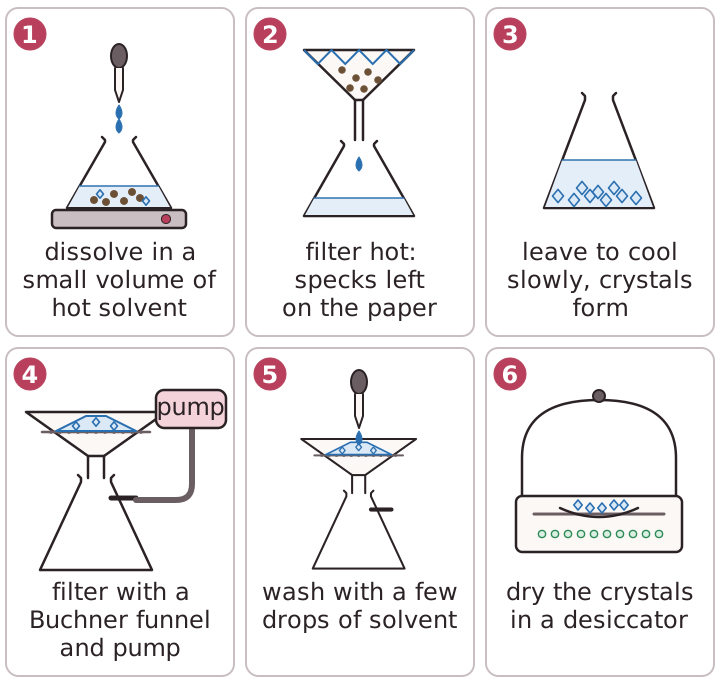 Using the minimum volume of solvent matters: if too much is used, more of the product stays dissolved when the solution cools, which lowers the yield. Washing with cold rather than warm solvent avoids redissolving the crystals.Some product is always lost, because a little stays dissolved in the cold solvent.Worked example: 5.00 g of crude solid is recrystallised and 3.80 g of dry pure crystals is obtained. Percentage recovery = 3.80 ÷ 5.00 × 100 = 76.0%.The purity of the crystals is then checked by measuring their melting temperature.
2. Filter the hot solution quickly through a warmed funnel to remove insoluble impurities. The funnel is warmed so the product does not crystallise in it.
3. Leave the filtrate to cool slowly. The solubility of the product falls and pure crystals form. Soluble impurities are present in small amounts, so they stay dissolved.
4. Collect the crystals by filtration under reduced pressure using a Buchner funnel.
5. Wash the crystals with a small amount of cold solvent to remove the solution left on their surface.
6. Dry the crystals, for example in a desiccator or a low-temperature oven.
Using the minimum volume of solvent matters: if too much is used, more of the product stays dissolved when the solution cools, which lowers the yield. Washing with cold rather than warm solvent avoids redissolving the crystals.Some product is always lost, because a little stays dissolved in the cold solvent.Worked example: 5.00 g of crude solid is recrystallised and 3.80 g of dry pure crystals is obtained. Percentage recovery = 3.80 ÷ 5.00 × 100 = 76.0%.The purity of the crystals is then checked by measuring their melting temperature.