Grignard reagents are made by reacting a halogenoalkane (or halogenoarene) with magnesium metal in dry ether (ethoxyethane):CH3CH2Br + Mg → CH3CH2MgBr Magnesium turnings are placed in a flask with dry ether, and the halogenoalkane is added gradually. The reaction is exothermic, and the mixture is heated gently under reflux to complete it. A small crystal of iodine is often added to start the reaction by cleaning the oxide layer from the magnesium surface.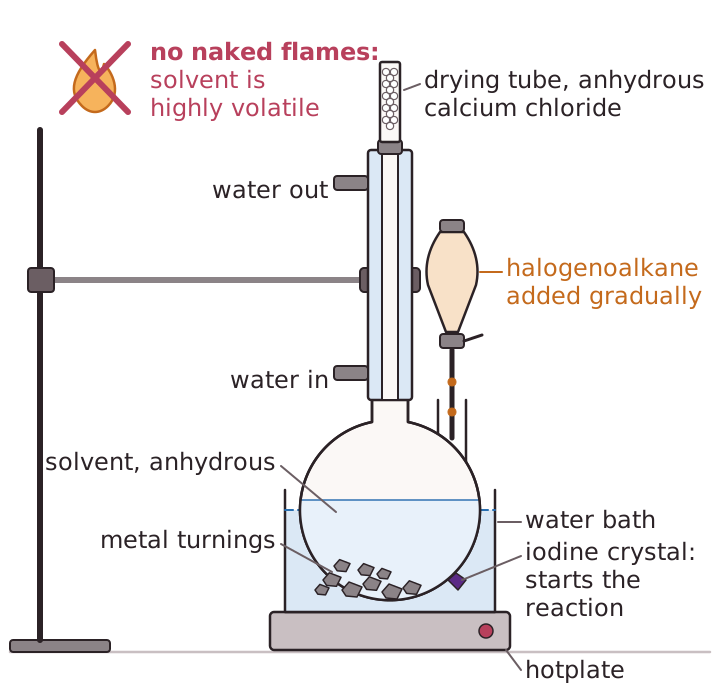 Why everything must be dry. Water reacts with the Grignard reagent and destroys it, forming an alkane:
CH3CH2MgBr + H2O → CH3CH3 + Mg(OH)Br So the ether must be anhydrous, the glassware is dried in an oven before use, and a drying tube containing anhydrous calcium chloride is fitted to the top of the condenser to keep out moisture from the air. Ether is used because it does not react with the reagent, and its oxygen lone pairs help to stabilise the magnesium compound.Safety. Ether is extremely volatile and highly flammable, so there must be no naked flames nearby. It is heated with a water bath or an electric heater.Aryl Grignard reagents are made in the same way: bromobenzene and magnesium in dry ether give phenylmagnesium bromide, C6H5MgBr.Worked example: what mass of magnesium reacts with 10.9 g of bromoethane (Mr = 109.0)? Amount = 10.9 ÷ 109.0 = 0.100 mol. The ratio is 1 : 1, so 0.100 mol of Mg is needed: 0.100 × 24.3 = 2.43 g.
Why everything must be dry. Water reacts with the Grignard reagent and destroys it, forming an alkane: