To decide whether a molecule is chiral, look for a chiral centre: a carbon atom with four different groups attached. A chiral centre is usually marked with an asterisk (*) on the structure.A quick method:
1. Draw the displayed or skeletal formula so you can see every group.
2. Rule out carbons that cannot be chiral centres:
• any carbon in a C=C or C=O double bond, because it has only three groups attached
• CH3 and CH2 carbons, because they have two or more identical hydrogen atoms
3. For each remaining carbon, list the four groups attached. Look at the whole group, not just the first atom: CH3 and CH2CH3 both start with carbon, but they are different groups.
4. If all four groups are different, the carbon is a chiral centre.Worked example 1: 2-bromobutane, CH3CHBrCH2CH3.
Carbon 2 is bonded to H, Br, CH3 and CH2CH3. All four are different, so C2 is a chiral centre: CH3C*HBrCH2CH3.Worked example 2: 3-bromopentane, CH3CH2CHBrCH2CH3.
Carbon 3 is bonded to H, Br and two CH2CH3 (ethyl) groups. Two groups are the same, so there is no chiral centre.Worked example 3: 2-aminopropanoic acid (alanine), CH3CH(NH2)COOH.
Carbon 2 carries H, NH2, CH3 and COOH, so it is a chiral centre. Most amino acids are chiral for this reason; the exception is glycine, H2NCH2COOH, which has two H atoms on that carbon.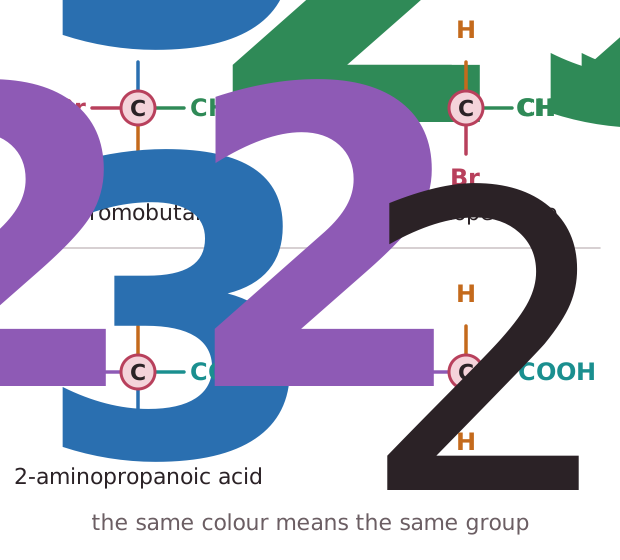 Some molecules have more than one chiral centre, so check every carbon that could fit the rule.
1. Draw the displayed or skeletal formula so you can see every group.
2. Rule out carbons that cannot be chiral centres:
• any carbon in a C=C or C=O double bond, because it has only three groups attached
• CH3 and CH2 carbons, because they have two or more identical hydrogen atoms
3. For each remaining carbon, list the four groups attached. Look at the whole group, not just the first atom: CH3 and CH2CH3 both start with carbon, but they are different groups.
4. If all four groups are different, the carbon is a chiral centre.Worked example 1: 2-bromobutane, CH3CHBrCH2CH3.
Carbon 2 is bonded to H, Br, CH3 and CH2CH3. All four are different, so C2 is a chiral centre: CH3C*HBrCH2CH3.Worked example 2: 3-bromopentane, CH3CH2CHBrCH2CH3.
Carbon 3 is bonded to H, Br and two CH2CH3 (ethyl) groups. Two groups are the same, so there is no chiral centre.Worked example 3: 2-aminopropanoic acid (alanine), CH3CH(NH2)COOH.
Carbon 2 carries H, NH2, CH3 and COOH, so it is a chiral centre. Most amino acids are chiral for this reason; the exception is glycine, H2NCH2COOH, which has two H atoms on that carbon.
Some molecules have more than one chiral centre, so check every carbon that could fit the rule.