Aldehydes and ketones are carbonyl compounds: they contain the carbonyl group, C=O.• In an aldehyde, the carbonyl carbon is bonded to at least one hydrogen atom, so the C=O is at the end of a carbon chain. The general formula is RCHO, where R is an alkyl group or H. Examples: methanal, HCHO, and ethanal, CH3CHO.
• In a ketone, the carbonyl carbon is bonded to two carbon atoms, so the C=O is within the chain. The general formula is RCOR', where R and R' are alkyl or aryl groups. The simplest ketone is propanone, CH3COCH3.Aldehydes and ketones with the same number of carbon atoms are functional group isomers. For example, propanal, CH3CH2CHO, and propanone both have the molecular formula C3H6O.The carbonyl group: the groups around the carbonyl carbon are trigonal planar, with bond angles of about 120°. Oxygen is more electronegative than carbon, so the C=O bond is polar, Cδ+=Oδ−. Nucleophiles attack the δ+ carbon, so a typical reaction of both aldehydes and ketones is nucleophilic addition, for example with HCN.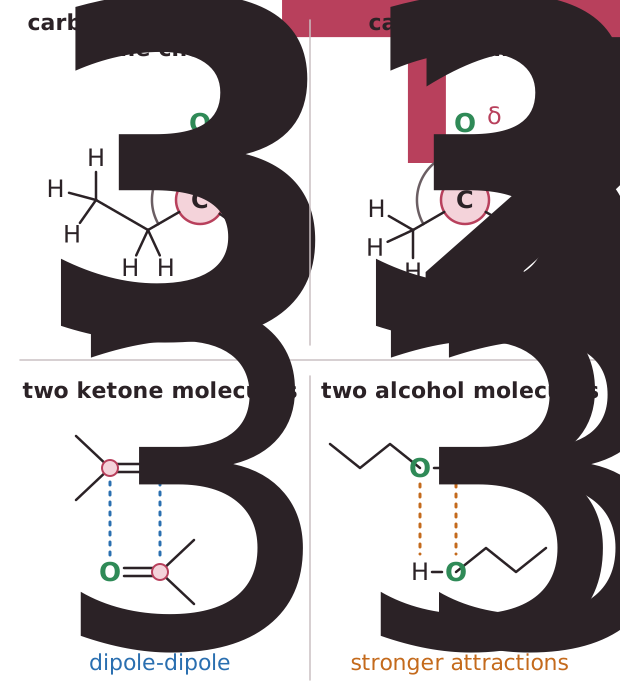 The key difference: aldehydes have an H atom on the carbonyl carbon, so they are easily oxidised to carboxylic acids. Ketones are not easily oxidised. This difference is the basis of the tests used to tell them apart.Aldehydes are made by oxidising primary alcohols, and ketones by oxidising secondary alcohols. Both can be reduced back to alcohols by LiAlH4 in dry ether.
• In a ketone, the carbonyl carbon is bonded to two carbon atoms, so the C=O is within the chain. The general formula is RCOR', where R and R' are alkyl or aryl groups. The simplest ketone is propanone, CH3COCH3.Aldehydes and ketones with the same number of carbon atoms are functional group isomers. For example, propanal, CH3CH2CHO, and propanone both have the molecular formula C3H6O.The carbonyl group: the groups around the carbonyl carbon are trigonal planar, with bond angles of about 120°. Oxygen is more electronegative than carbon, so the C=O bond is polar, Cδ+=Oδ−. Nucleophiles attack the δ+ carbon, so a typical reaction of both aldehydes and ketones is nucleophilic addition, for example with HCN.
The key difference: aldehydes have an H atom on the carbonyl carbon, so they are easily oxidised to carboxylic acids. Ketones are not easily oxidised. This difference is the basis of the tests used to tell them apart.Aldehydes are made by oxidising primary alcohols, and ketones by oxidising secondary alcohols. Both can be reduced back to alcohols by LiAlH4 in dry ether.