A racemic mixture (or racemate) is a mixture containing equal amounts of the two enantiomers of a chiral compound.A racemic mixture is optically inactive: it does not rotate plane-polarised light. Each enantiomer rotates the plane by the same angle in opposite directions, so the two effects cancel out. The individual molecules are still chiral; it is the mixture as a whole that shows no rotation.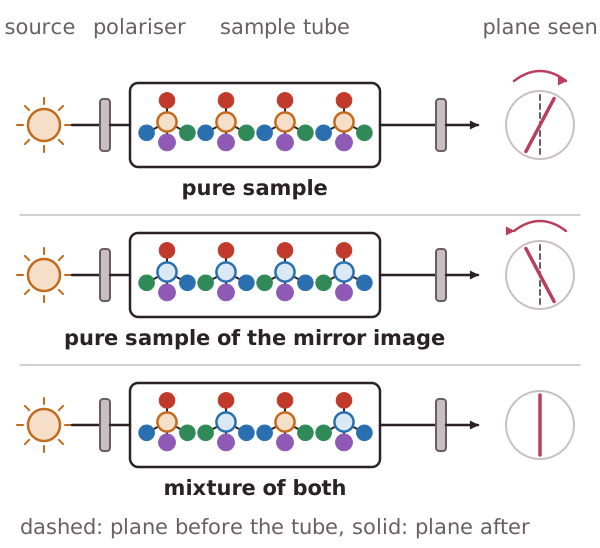 Worked example: a solution of one pure enantiomer rotates plane-polarised light by 20° clockwise. A racemic mixture at the same total concentration gives a rotation of 0°. Now consider a mixture of 75% of the clockwise enantiomer and 25% of the other. The 25% of the anticlockwise form cancels 25% of the clockwise form, leaving a 50% excess of the clockwise enantiomer. The rotation is 50% of 20° = 10° clockwise.How racemates form: when a reaction creates a chiral centre from a starting material that is not chiral, and each enantiomer is equally likely to form, a racemic mixture is produced. This happens when a planar reactant or intermediate can be attacked equally from either side, as in the next lesson.Why it matters: many drugs are chiral, and often only one enantiomer has the desired effect. The other may be inactive or cause side effects. Thalidomide was sold as a racemic mixture in the 1950s and 1960s; one enantiomer is a sedative, but the drug caused serious harm to unborn babies. Making a racemate and then separating the enantiomers is expensive, so drug companies try to make only the active enantiomer, for example using enzymes or chiral catalysts. This also reduces waste and the dose needed.