 BRAINCAKE
Optical Isomers
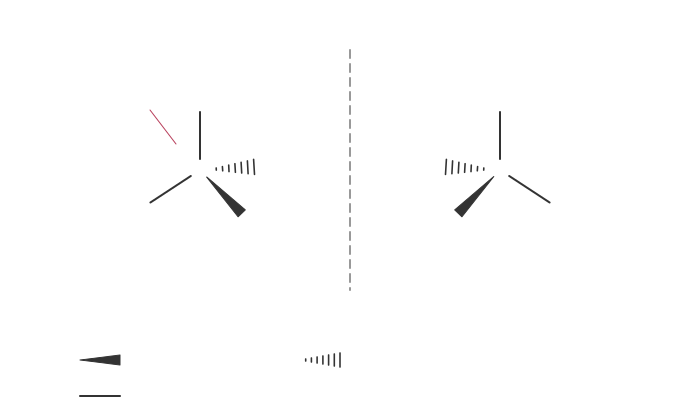
A chiral molecule exists as two optical isomers, also called enantiomers. They are non-superimposable mirror images of each other. Optical isomerism is a type of stereoisomerism: both isomers have the same structural formula, but a different arrangement of groups in space.
Drawing optical isomers: use 3D formulae around the chiral carbon.
• Draw two bonds in the plane of the paper as ordinary lines.
• Draw one bond coming towards you as a solid wedge.
• Draw one bond going away from you as a dashed wedge.
Then draw the second isomer as the reflection of the first, with a vertical dashed line between them to represent the mirror.
Sign in free to see the rest of this lesson, the R.E.C.I.P.E. recall steps and the quiz
BrainCake is free. Make an account in seconds and pick up where this page stops.
Key terms in this lesson
- optical activity
- The ability of a substance to rotate the plane of plane-polarised light.
More in Chirality
- Chirality
- Plane-Polarised Light
- Racemic Mixtures
- Racemates from Nucleophilic Addition
- Identifying Chiral Centres
All 6 lessons in Chirality · All Edexcel A-level Chemistry topics