Ordinary light is made of electromagnetic waves that vibrate in all planes at right angles to the direction the light travels. When light passes through a polarising filter, only the waves vibrating in one plane get through. This is plane-polarised light.When plane-polarised light passes through a solution of a single optical isomer, the plane of polarisation is rotated. Optical activity is the ability of a single optical isomer to rotate the plane of polarisation of plane-polarised light, and such a substance is described as optically active.The two enantiomers of a compound rotate the plane by the same angle but in opposite directions: one clockwise and the other anticlockwise. This is the simplest physical way to tell a pair of enantiomers apart.Measuring optical activity with a polarimeter:
1. Light passes through a polarising filter (the polariser) to produce plane-polarised light.
2. The plane-polarised light passes through a tube containing a solution of the sample.
3. A second polarising filter (the analyser) is turned until the most light gets through. The angle it is turned through is the angle of rotation.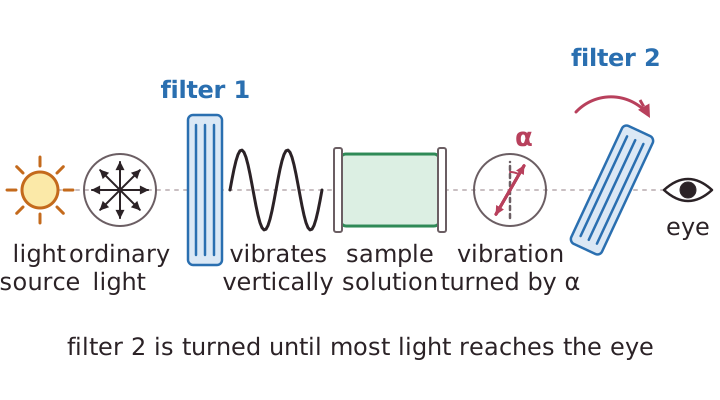 The size of the rotation depends on the compound, the concentration of the solution, the length of the tube, the temperature and the wavelength of the light.Example: if a solution of one enantiomer of butan-2-ol rotates plane-polarised light by 13° clockwise, a solution of the other enantiomer at the same concentration, under the same conditions, rotates it by 13° anticlockwise.A compound that is not chiral, such as propan-2-ol, does not rotate plane-polarised light at all.
1. Light passes through a polarising filter (the polariser) to produce plane-polarised light.
2. The plane-polarised light passes through a tube containing a solution of the sample.
3. A second polarising filter (the analyser) is turned until the most light gets through. The angle it is turned through is the angle of rotation.
The size of the rotation depends on the compound, the concentration of the solution, the length of the tube, the temperature and the wavelength of the light.Example: if a solution of one enantiomer of butan-2-ol rotates plane-polarised light by 13° clockwise, a solution of the other enantiomer at the same concentration, under the same conditions, rotates it by 13° anticlockwise.A compound that is not chiral, such as propan-2-ol, does not rotate plane-polarised light at all.