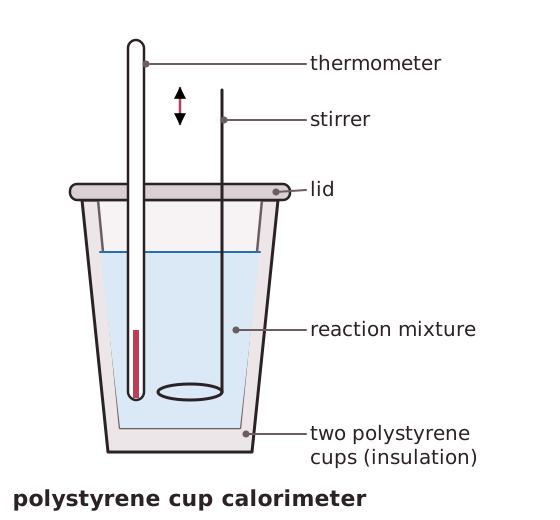
The standard enthalpy of neutralisation ΔHneut is the enthalpy change when an acid and a base react to form 1 mole of water under standard conditions (1.0 moldm-3, 298K, 100kPa). The enthalpy of neutralisation is the sum of the enthalpy of ionisation of the acid and base and the enthalpy of the reactionH+ + OH- → H2OThe enthalpy of neutralisation is always exothermic. To determine the enthalpy of neutralisation by experiment, the acid and base are placed in a polystyrene cup. The temperature before and after the reaction are taken. The enthalpy of the reaction can be found usingq = mcΔT
Standard Enthalpy of Neutralisation
Read the text
Read the text and highlight anything you think is important. When you go on, the text is hidden and you answer from memory.
Specification: Edexcel Chemistry (9CH0), A-level, Topic 12: Acid-base Equilibria. Topic: Acids, Bases and Buffers.
More in Acids, Bases and Buffers
- Calculating the pH of a Weak Acid
- The Ionic Product of Water Kw
- Calculating the pH of a Strong Base
- Buffer Solutions
- pH of a Buffer Solution
- Controlling the pH of Blood
- Titration Curves
- Acid-Base Indicators
All 16 lessons in Acids, Bases and Buffers · All Edexcel A-level Chemistry topics