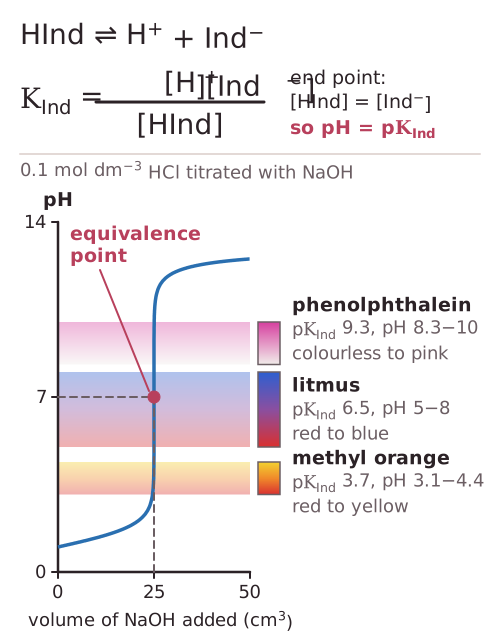
An acid-base indicator is a weak acid which is one colour in its un-ionised form and another in its dissociated form.HInd ⇌ H+ + Ind-For methyl orange HInd is red and Ind- is yellow. For Litmus HLit is red and Lit- is blue. For phenolphthalein HInd is colourless and Ind- is pink.When [HInd] = [Ind-] the indicator is at its end point. The end point of an indicator is the point at which there is an equal concentration of the weak acid and the conjugate base. The colour is mid-way between the colours of the acid and conjugate base forms. Most indicators change colour over a range of about 2 pH values.For a titration, it is necessary to choose an indicator with an end point as close as possible to the equivalence point. The entire range during which it changes colour must be completely within the vertical section of the titration curve. The indicator chosen will depend on the strength of the acid and base and shape of the titration curve.For a strong acid and strong base both methyl orange and phenolphthalein can be used. For a strong acid and weak base only methyl orange can be used. For a weak acid and strong base only phenolphthalein can be used. For a weak acid and weak base neither methyl orange nor phenolphthalein can be used.The pKInd is -log10 of the dissociation constant of the indicator, KInd. The end point is at pH = pKInd.