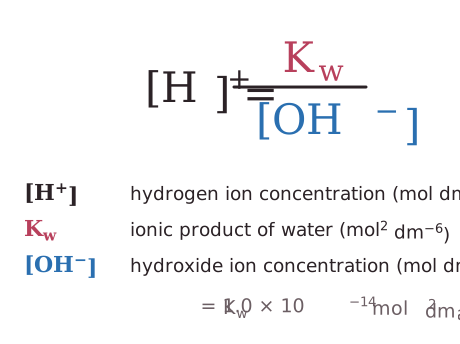
The strength of a base is its ability to dissociate and generate OH- ions in solution. Strong bases are alkalis. They dissociate completely to give hydroxide ions and cations. For example, sodium hydroxide is a strong base.NaOH(aq) → Na+(aq) + OH-(aq)Since pH = -log10[H+] we need to know the hydrogen ion concentration in order to find the pH. We can use the fact that Kw = [H+] [OH-] = 1.0 x 10⁻¹⁴ at 25°C to find the hydrogen ion concentration.For a 0.2 moldm-3 solution of NaOH, the [H+] = Kw/ [OH-] and [H+] = 1 x 10-14/ 0.2pH = -log10 (1 x 10-14/ 0.2) = 13.3
Calculating the pH of a Strong Base
Read the text
Read the text and highlight anything you think is important. When you go on, the text is hidden and you answer from memory.
Specification: Edexcel Chemistry (9CH0), A-level, Topic 12: Acid-base Equilibria. Topic: Acids, Bases and Buffers.
More in Acids, Bases and Buffers
- pH
- Calculating the pH of a Strong Acid
- Calculating the pH of a Weak Acid
- The Ionic Product of Water Kw
- Buffer Solutions
- pH of a Buffer Solution
- Controlling the pH of Blood
- Titration Curves
All 16 lessons in Acids, Bases and Buffers · All Edexcel A-level Chemistry topics