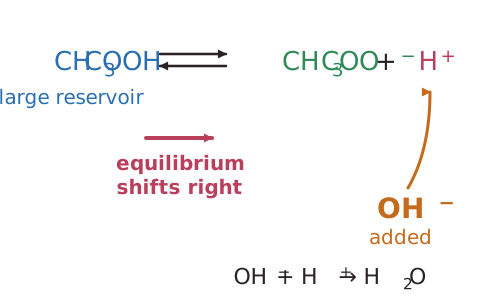
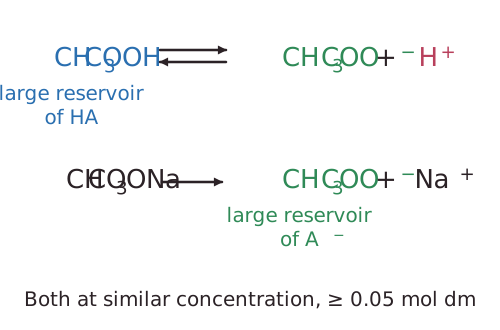
A buffer solution resists changes in pH when small amounts of acid or alkali are added. An acidic buffer solution is a mixture of a weak acid HA and its conjugate base A-. This gives such a large reservoir of HA and a large reservoir of A- ions that any small increase or decrease in HA or A- ions will be negligible.When small amounts of H+ ions are added they react with the A- ions and the equilibrium shifts to the left restoring the concentration of H+ ions to the previous level so the pH does not change.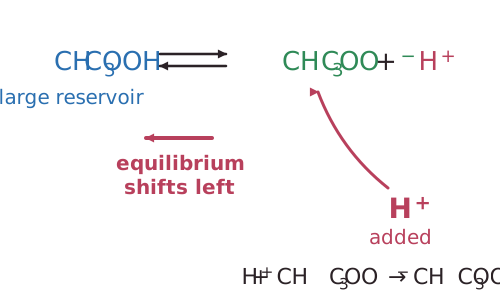 When small amounts of OH- ions are added they react with the H+ ions and the equilibrium shifts to the right to replace the H+ ions, restoring the concentration of H+ ions to the previous level so the pH does not change.
 The acid and conjugate base should be at a similar concentration, not less than 0.05moldm-3.
When small amounts of OH- ions are added they react with the H+ ions and the equilibrium shifts to the right to replace the H+ ions, restoring the concentration of H+ ions to the previous level so the pH does not change.The acid and conjugate base should be at a similar concentration, not less than 0.05moldm-3.