In a high-resolution 1H NMR spectrum, many peaks are not single lines. They are split into a group of closely spaced lines called a multiplet. This is spin-spin splitting (also called spin-spin coupling).It happens because each H nucleus acts as a small magnet. The H atoms on an adjacent carbon atom can each line up with or against the applied field. The different combinations slightly change the magnetic field felt by the H atoms being observed, so their peak is split into several lines.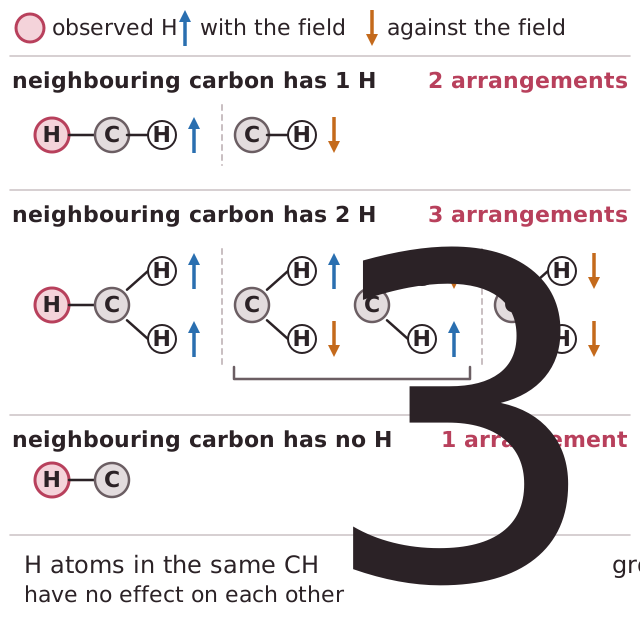 Multiplets are named by the number of lines:
• 1 line: singlet
• 2 lines: doublet
• 3 lines: triplet
• 4 lines: quartetImportant points:
• Splitting is caused by H atoms on adjacent carbon atoms. H atoms further away do not normally split the peak.
• H atoms in the same environment do not split each other. For example, the six equivalent H atoms of ethane, CH3CH3, give a singlet.
• The H of an O-H group usually appears as a singlet and does not split neighbouring peaks.The splitting pattern tells you which groups sit next to each other. The exact link between the number of lines and the number of adjacent H atoms is the n+1 rule, covered in the next lesson.Example: an ethyl group, -CH2CH3, has a very recognisable pattern: a quartet from the CH2 and a triplet from the CH3. Seeing this pair in a spectrum is a strong sign that an ethyl group is present.
Multiplets are named by the number of lines:• 1 line: singlet
• 2 lines: doublet
• 3 lines: triplet
• 4 lines: quartetImportant points:
• Splitting is caused by H atoms on adjacent carbon atoms. H atoms further away do not normally split the peak.
• H atoms in the same environment do not split each other. For example, the six equivalent H atoms of ethane, CH3CH3, give a singlet.
• The H of an O-H group usually appears as a singlet and does not split neighbouring peaks.The splitting pattern tells you which groups sit next to each other. The exact link between the number of lines and the number of adjacent H atoms is the n+1 rule, covered in the next lesson.Example: an ethyl group, -CH2CH3, has a very recognisable pattern: a quartet from the CH2 and a triplet from the CH3. Seeing this pair in a spectrum is a strong sign that an ethyl group is present.