13C NMR spectroscopy gives information about the carbon atoms in a molecule. Only about 1% of carbon atoms are 13C; the rest are 12C, which gives no signal. Modern spectrometers are sensitive enough to detect this small fraction.Each peak in a 13C spectrum represents one carbon environment. Carbon atoms are in the same environment if they are bonded to exactly the same groups, which usually happens because of symmetry in the molecule. So:number of peaks = number of different carbon environments The TMS peak at 0 ppm is not counted.Features of 13C spectra at A level:
• The chemical shift range is wide, about 0 to 220 ppm, so peaks rarely overlap.
• Each environment appears as a single line; you do not need to consider splitting in 13C spectra.
• Peak heights are not proportional to the number of carbon atoms, so you cannot count carbons from peak size.
• The chemical shift of each peak shows what the carbon is bonded to (use the data booklet).Worked example: how many peaks are in the 13C spectra of propan-1-ol and propan-2-ol?
Propan-1-ol, CH3CH2CH2OH: each carbon is bonded to different groups, so there are 3 peaks.
Propan-2-ol, CH3CH(OH)CH3: the two CH3 carbons are equivalent by symmetry, and the central carbon is different, so there are 2 peaks.This lets you tell the two isomers apart, even though they have the same molecular formula.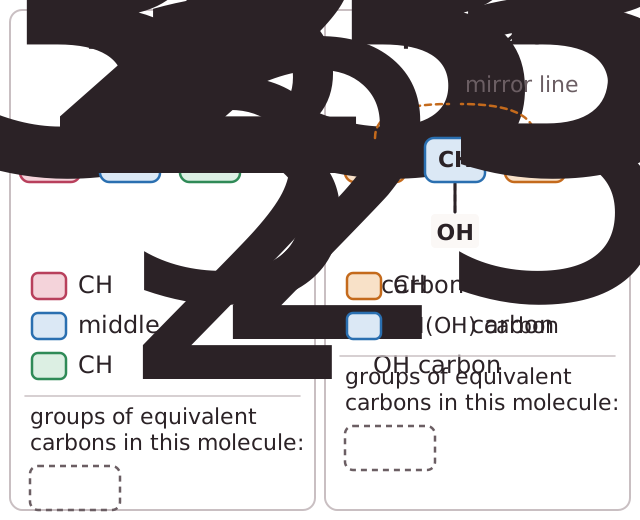
• The chemical shift range is wide, about 0 to 220 ppm, so peaks rarely overlap.
• Each environment appears as a single line; you do not need to consider splitting in 13C spectra.
• Peak heights are not proportional to the number of carbon atoms, so you cannot count carbons from peak size.
• The chemical shift of each peak shows what the carbon is bonded to (use the data booklet).Worked example: how many peaks are in the 13C spectra of propan-1-ol and propan-2-ol?
Propan-1-ol, CH3CH2CH2OH: each carbon is bonded to different groups, so there are 3 peaks.
Propan-2-ol, CH3CH(OH)CH3: the two CH3 carbons are equivalent by symmetry, and the central carbon is different, so there are 2 peaks.This lets you tell the two isomers apart, even though they have the same molecular formula.