The standard hydrogen half cell, consists of hydrogen gas at 100kPa in contact with a platinum electrode which is dipped into an acidic solution (e.g. HCl) containing 1 moldm-3 of H+ ions at 298K.2H+(aq) + 2 e- ⇌ H2(g)It is always drawn on the left of a diagram or cell diagram. The standard electrode potential of a hydrogen electrode is 0V by definition. It is used as a reference standard for the measurement of the cell e.m.f.
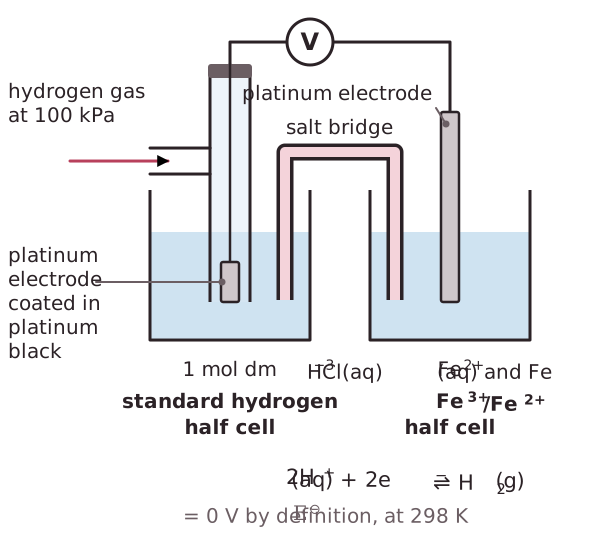
The Standard Hydrogen Half Cell
Read the text
Read the text and highlight anything you think is important. When you go on, the text is hidden and you answer from memory.
Specification: AQA Chemistry (7405), A-level, 3.1.11.1 Electrode potentials and cells. Topic: Electrochemistry.
Key terms in this lesson
- entropy
- A measure of the number of ways particles and energy can be arranged in a system, often described as the amount of disorder.
More in Electrochemistry
- Oxidation and Reduction
- Ionic Equations
- Electrochemical Half Cells
- Electrochemical Cells
- Standard Electrode Potential Eθ and the Electrochemical Series
- Calomel Electrode
- Standard Cell Potentials Eθcell Values and Electrochemical Cells
- Non-Standard Conditions
All 14 lessons in Electrochemistry · All AQA A-level Chemistry topics