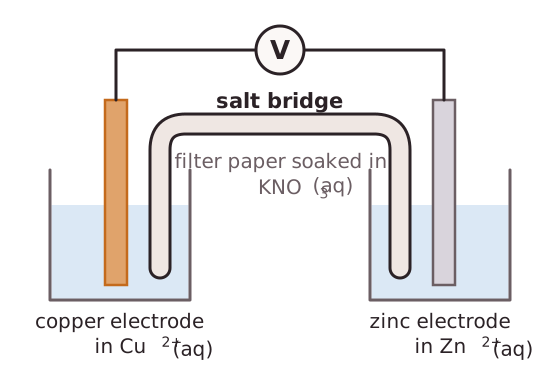
An electrochemical cell can be made by connecting two half cells together. Each half cell has a different potential so one half cell has a greater tendency to accept electrons than the other. As a result, one half cell releases electrons and the other half gains electrons. The difference in electrode potentials between the two cells, the potential difference, is measured with a voltmeter. The circuit is completed with a salt bridge which is a piece of filter paper soaked in aqueous potassium or ammonium nitrate or potassium chloride. The salt bridge is soaked in an ionic compound that does not react with either of the solutions in the half cells.An electrical current flows in the circuit. The current is created by the movement of ions in the solution and through the salt bridge and the movement of electrons in the wires. The electrode in the half cell with the greater tendency to accept electrons becomes the positive electrode. In the Zn/Cu cell, the copper electrode is the positive electrode as copper has a greater tendency to accept electrons than zinc.Cu2+(aq) + 2e- ⇌ Cu(s)The electrode in the half cell with the lesser tendency to accept electrons becomes the negative electrode. The zinc electrode is the negative electrode as zinc has less tendency to accept electrons than copper.Zn(s) ⇌ Zn2+(aq) + 2e-If a half-cell has both oxidation states as ions then a platinum electrode or other inert electrode is used.