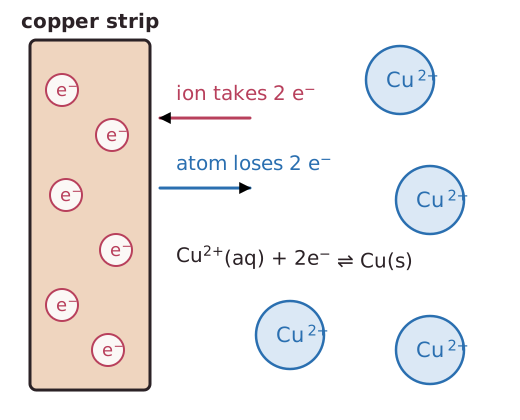
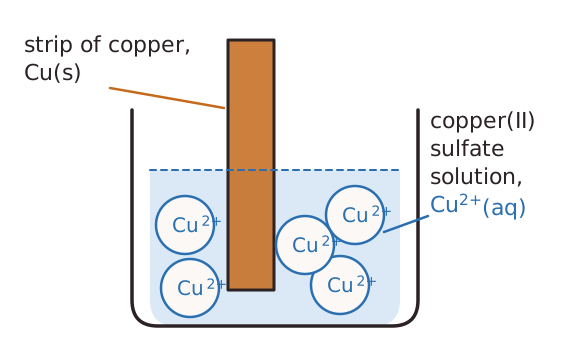
A half cell is made of an element in two different oxidation states. The simplest half cell has a strip of metal placed in an aqueous solution of its ions. For example Cu(s) metal and aqueous Cu2+ ions (copper sulfate solution). An equilibrium exists at the surface of the metal.Cu2+(aq) +2 e- ⇌ Cu(s)By convention the equilibrium is written with electrons on the left-hand side. The aqueous copper ions take electrons from the strip of copper and become copper atoms. The copper atoms on the strip of copper lose electrons and become Cu2+ and dissolve in the waterCu(s) ⇌ Cu2+ + 2e-This sets up a potential difference between the metal strip and the aqueous ions. The size of the potential difference depends on the position of equilibrium.