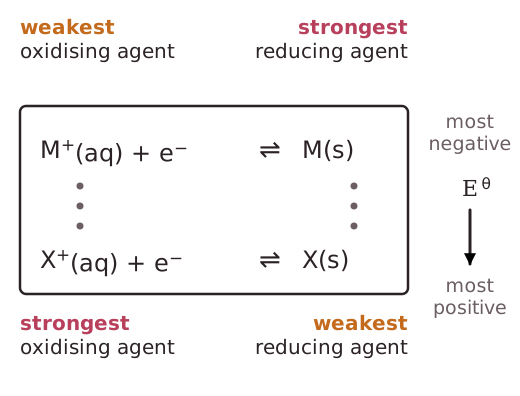
A copper rod dipped in a solution of copper ions generates a potential relative to the solution. This potential cannot be measured but can only be compared to the potential of another half cell. The potential difference between the half cell and a standard hydrogen half-cell can be measured.The hydrogen electrode has an electrode potential of 0.0V by definition. The standard electrode potential of the half cell Eθ indicates its tendency to gain or lose electrons compared to a standard hydrogen half cell. The standard electrode potential Eθ is the e.m.f. of a half cell compared with the standard hydrogen half cell under standard conditions. Standard conditions are 298K, 100kPa (1 atm pressure) and all solutions at a concentration of 1 moldm-3.2H+ + 2e- ⇌ H2(g) +0.0VCu2+ + 2e- ⇌ Cu(s) +0.34VThe Electrochemical SeriesStandard electrode potentials can be listed in numerical order. They are listed with the most negative at the top and then in increasing order and the most positive at the bottom. This means that the weakest oxidising agent is at the top on the left-hand side. The strongest reducing agent is at the top on the right hand side. The strongest oxidising agent is at the bottom on the left hand side. The weakest reducing agent is at the bottom on the right hand side.