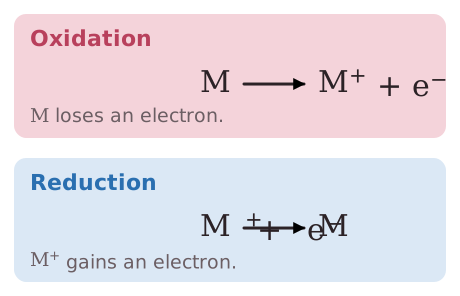
Ionic half-equations show either the species that are oxidisedAl → Al3+ + 3e-or the species that are reducedCu2+ + 2e- → CuThey can be combined to give the overall ionic equation by balancing the equations so they have the same number of electrons2Al → 2Al3+ + 6e-3Cu2+ + 6e- → 3Cuthen adding the two equations with the electrons cancelled out.2Al + 3Cu2+ → 2Al3+ + 3CuIn the overall equation the electrons cancel because electrons are transferred from one species to another so the number of electrons lost by one species is equal to the number of electrons gained by the other species. The total change in oxidation number of the species being oxidised is equal to the total change in oxidation number of the species being reduced.
Ionic Equations
Read the text
Read the text and highlight anything you think is important. When you go on, the text is hidden and you answer from memory.
Specification: AQA Chemistry (7405), A-level, 3.1.11.1 Electrode potentials and cells. Topic: Electrochemistry.
Key terms in this lesson
- entropy
- A measure of the number of ways particles and energy can be arranged in a system, often described as the amount of disorder.
More in Electrochemistry
- Oxidation and Reduction
- Electrochemical Half Cells
- Electrochemical Cells
- The Standard Hydrogen Half Cell
- Standard Electrode Potential Eθ and the Electrochemical Series
- Calomel Electrode
- Standard Cell Potentials Eθcell Values and Electrochemical Cells
- Non-Standard Conditions
All 14 lessons in Electrochemistry · All AQA A-level Chemistry topics