In TLC, each component moves a characteristic distance relative to the solvent. This is measured by its Rf value:Rf = distance moved by the spot ÷ distance moved by the solvent front Both distances are measured from the baseline, and the spot distance is measured to the centre of the spot. A spot can never move further than the solvent, so Rf is always between 0 and 1. It has no units.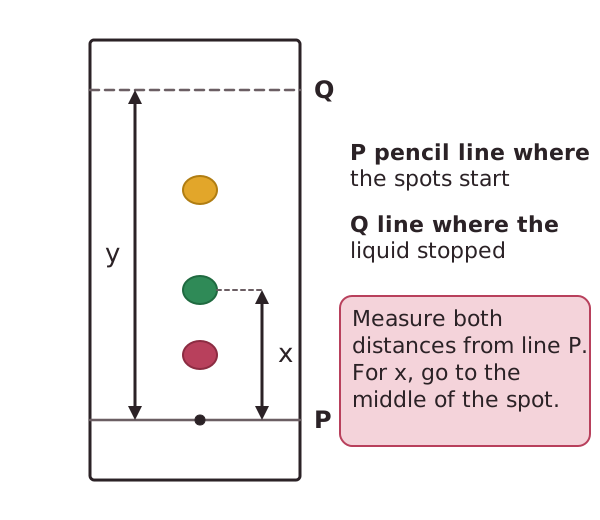 Worked example: the solvent front moves 8.0 cm from the baseline and a spot moves 3.6 cm.
Rf = 3.6 ÷ 8.0 = 0.45 A substance with a high Rf is more soluble in the mobile phase or held less strongly by the stationary phase. A substance with a low Rf is adsorbed more strongly onto the stationary phase.Using Rf values to identify substances: the Rf value of a compound depends on the conditions, including the solvent, the type of plate and the temperature. So an unknown is identified by comparing its Rf value with those of known substances measured under the same conditions, ideally on the same plate at the same time.Two different compounds can have similar Rf values in one solvent. If the result is unclear, running another plate with a different solvent helps to confirm the identity.Working backwards: if Rf = 0.60 and the solvent front moved 5.0 cm, the spot moved 0.60 × 5.0 = 3.0 cm.
Worked example: the solvent front moves 8.0 cm from the baseline and a spot moves 3.6 cm.