Gas chromatography separates a mixture very well, but retention times alone cannot always identify a component, because different substances can have similar retention times. Mass spectrometry (MS) identifies substances well but needs a pure sample. Combining them in GC-MS uses the strengths of both.How GC-MS works: the outlet of the gas chromatography column is connected directly to a mass spectrometer. As each separated component leaves the column, it passes straight into the mass spectrometer, which records its mass spectrum.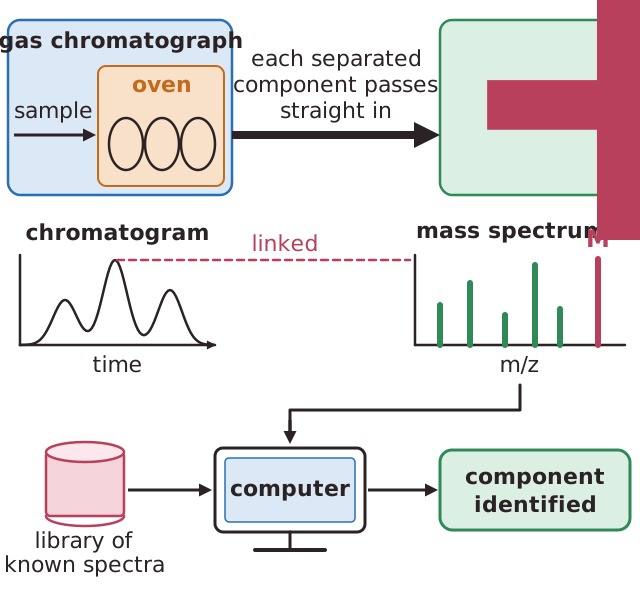 The result is a chromatogram with a peak for each component, plus a mass spectrum for each peak. The mass spectrum shows the molecular ion peak, which gives the relative molecular mass (Mr), and a fragmentation pattern. A computer compares each spectrum with a database of known spectra, so each component can be identified quickly and with confidence.Example: a peak in the chromatogram of a blood sample gives a mass spectrum with a molecular ion peak at m/z = 46. The fragmentation pattern matches the database entry for ethanol, C2H5OH (Mr = 46), confirming that the sample contains alcohol.Uses of GC-MS:
• forensics, for example identifying substances found at crime scenes
• testing athletes' urine for banned drugs
• airport security, detecting explosives
• monitoring pollutants in air and water
• food analysis, such as detecting pesticide residuesGC-MS is very sensitive, so only a tiny sample is needed and substances present in very small amounts can be detected.
The result is a chromatogram with a peak for each component, plus a mass spectrum for each peak. The mass spectrum shows the molecular ion peak, which gives the relative molecular mass (Mr), and a fragmentation pattern. A computer compares each spectrum with a database of known spectra, so each component can be identified quickly and with confidence.Example: a peak in the chromatogram of a blood sample gives a mass spectrum with a molecular ion peak at m/z = 46. The fragmentation pattern matches the database entry for ethanol, C2H5OH (Mr = 46), confirming that the sample contains alcohol.Uses of GC-MS:• forensics, for example identifying substances found at crime scenes
• testing athletes' urine for banned drugs
• airport security, detecting explosives
• monitoring pollutants in air and water
• food analysis, such as detecting pesticide residuesGC-MS is very sensitive, so only a tiny sample is needed and substances present in very small amounts can be detected.