Gas chromatography (GC) separates mixtures of volatile substances: liquids or gases that can be vaporised without decomposing.The stationary phase is inside a long, thin column, coiled to fit inside an oven. The column is packed with a solid, or with a solid coated with a liquid. The mobile phase is an unreactive carrier gas such as nitrogen or helium, which flows through the column under pressure at high temperature.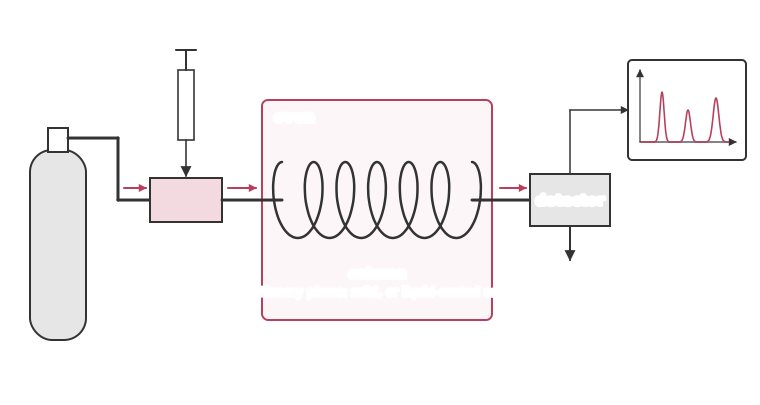
1. A tiny sample is injected into the heated inlet, where it vaporises.
2. The carrier gas sweeps the vapour into the column.
3. The components move through the column at different rates, depending on their balance between solubility in the stationary liquid (or adsorption onto the solid) and staying in the gas. Components that interact weakly with the stationary phase and are more volatile pass through faster.
4. A detector at the end of the column records each component as it leaves.The output is a chromatogram: a graph of detector signal against time, with a peak for each component. The time from injection to a peak is the retention time, which helps to identify the component, and the area under each peak shows how much of it is present.The oven temperature is controlled, because it affects how quickly components pass through. A higher temperature makes all components pass through faster, but can reduce the separation.Uses: GC is very sensitive, so it is used to detect small amounts of substances, for example alcohol in blood, drugs in urine and pollutants in air, and to check the purity of products.