In gas chromatography, the retention time of a substance is the time taken from injection of the sample to that substance reaching the detector. It is read from the chromatogram as the time at the top of the substance's peak.Under fixed conditions, each substance has a characteristic retention time. It depends on:
• how strongly the substance interacts with, or dissolves in, the stationary phase
• its volatility (boiling point)
• the conditions: column type and length, oven temperature and carrier gas flow rate.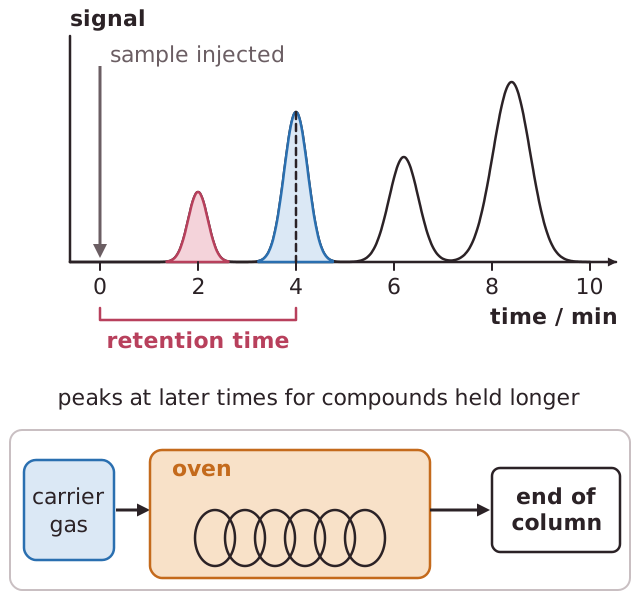 So, to identify a component, compare its retention time with those of known substances run on the same machine under the same conditions. Different substances can have similar retention times, so this alone does not always give a certain identification.Peak areas: the area under each peak is proportional to the amount of that component in the mixture. Comparing peak areas gives the relative amounts, for example as a percentage composition.Worked example: a chromatogram of a mixture of two esters shows peaks with areas of 36 units and 84 units.
Total area = 36 + 84 = 120 units
Percentage of the first ester = 36 ÷ 120 × 100 = 30%
Percentage of the second ester = 84 ÷ 120 × 100 = 70%This assumes the detector responds equally to both substances. For accurate amounts, the machine is calibrated using samples of known concentration.A substance with a longer retention time spends more time held by the stationary phase. For a series of similar compounds, such as straight-chain alkanes, retention time increases with boiling point.
• how strongly the substance interacts with, or dissolves in, the stationary phase
• its volatility (boiling point)
• the conditions: column type and length, oven temperature and carrier gas flow rate.
So, to identify a component, compare its retention time with those of known substances run on the same machine under the same conditions. Different substances can have similar retention times, so this alone does not always give a certain identification.Peak areas: the area under each peak is proportional to the amount of that component in the mixture. Comparing peak areas gives the relative amounts, for example as a percentage composition.Worked example: a chromatogram of a mixture of two esters shows peaks with areas of 36 units and 84 units.Total area = 36 + 84 = 120 units
Percentage of the first ester = 36 ÷ 120 × 100 = 30%
Percentage of the second ester = 84 ÷ 120 × 100 = 70%This assumes the detector responds equally to both substances. For accurate amounts, the machine is calibrated using samples of known concentration.A substance with a longer retention time spends more time held by the stationary phase. For a series of similar compounds, such as straight-chain alkanes, retention time increases with boiling point.