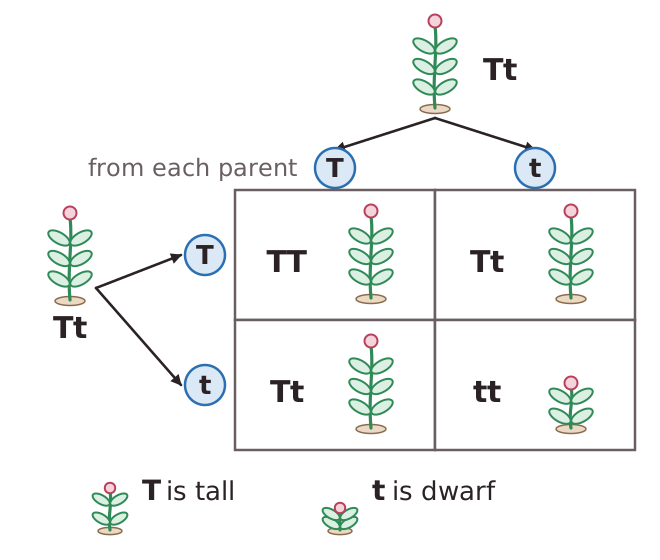
Some features are controlled by a single gene. Different versions of a gene are called alleles, and every body cell has two alleles of the gene, one from each parent. A dominant allele is shown in the phenotype even if only one copy is present, and it is written with a capital letter. A recessive allele is only shown in the phenotype if two copies are present, and it is written with a lower case letter.
An organism with two identical alleles is homozygous, for example TT (homozygous dominant) or tt (homozygous recessive). An organism with two different alleles is heterozygous, for example Tt. A heterozygous organism shows the dominant phenotype and carries the recessive allele without showing it.
In pea plants, T is the allele for tall and t is the allele for dwarf. A Tt parent makes gametes with T and gametes with t in equal numbers. If two Tt plants are crossed, each offspring has a 1 in 4 (25%) chance of being tt and dwarf, and a 3 in 4 (75%) chance of being tall, which is 3 tall to 1 dwarf. Crossing TT with tt gives offspring that are all Tt, so all are tall. Each offspring is a separate chance, like a coin toss, so a small family may not match the predicted ratio.