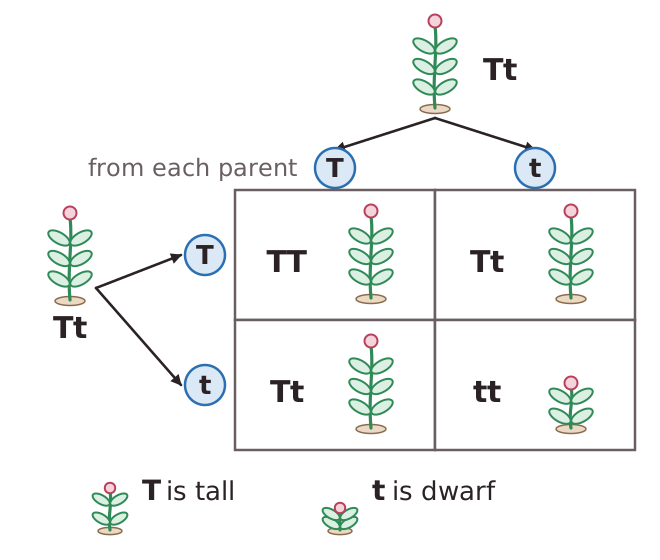
A Punnett square is a grid that shows every possible combination of alleles when gametes from two parents fuse. To use one, first write the genotype of each parent. Then work out the gametes, remembering that each gamete carries only one allele of the gene. Write one parent's gametes along the top and the other's down the side. Fill each box with the allele from its column and the allele from its row. Every box is equally likely, so the results can be given as a fraction, a percentage or a ratio.
Take two heterozygous tall pea plants, Tt x Tt. The boxes are TT, Tt, Tt and tt. Three of the four boxes show the tall phenotype, so the probability of a tall offspring is 3 in 4 (75%). Now take Tt x tt. The gametes are T and t from one parent, and t and t from the other. The boxes are Tt, tt, Tt and tt, so the phenotype ratio is 1 tall to 1 dwarf, and the probability of a dwarf offspring is 50%.
The same method works for inherited disorders. Cystic fibrosis is caused by a recessive allele, f. Two carriers (Ff) can have a child with the disorder. Their Punnett square gives FF, Ff, Ff and ff, so 1 in 4 (25%) of their children are expected to have cystic fibrosis, while 2 in 4 will be carriers like their parents.