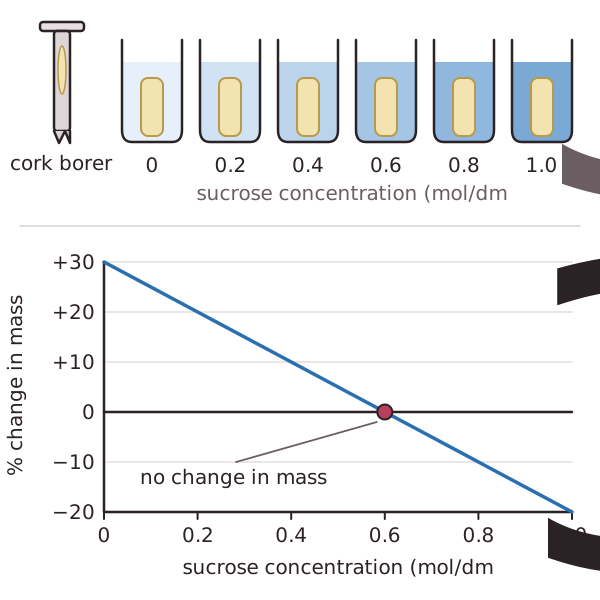
This practical looks at the exchange of water between potato tissue and sucrose solution. Use a cork borer to cut several potato cylinders, and trim them to the same length and diameter. Blot each one dry, then measure its initial mass. Place each cylinder in a different concentration of sucrose solution, for example 0, 0.2, 0.4, 0.6, 0.8 and 1.0 mol/dm3. The independent variable is the concentration of the sucrose solution. The dependent variable is the percentage change in mass.
Leave the cylinders for the same length of time. Then remove each one, blot it dry so that water on the surface does not affect the mass, and measure its final mass. Calculate the percentage change in mass for each cylinder. Repeating the experiment and calculating a mean makes the results more reliable.
In a dilute solution, water moves into the potato cells by osmosis and the cylinder gains mass. In a concentrated solution, water leaves the cells by osmosis and the cylinder loses mass. Plot percentage change in mass against sucrose concentration. Where the line crosses the x axis the percentage change is zero, so there is no net movement of water and the solution has the same concentration as the potato cells. For example, a line crossing at 0.3 mol/dm3 means the potato cells are equal to a 0.3 mol/dm3 solution.
To make the test fair, control the volume of solution, the temperature and the time, and use cylinders of the same size from the same potato. Take care with the cork borer and scalpel, which are sharp.