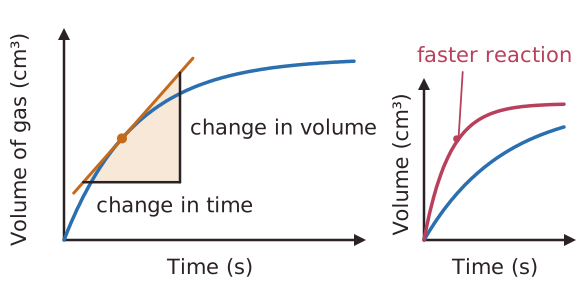
The rate of a reaction tells us how quickly it happens. For an enzyme, we can measure how much product forms in a given time, or how much substrate is used up. Rate = amount of product formed ÷ time. The units depend on what is measured, such as cm3/s for a gas or g/s for a mass. For example, 24 cm3 of gas in 40 s gives 24 ÷ 40 = 0.6 cm3/s.
Sometimes we only measure the time a reaction takes to finish. Then rate = 1 ÷ time, so a reaction that finishes in 20 s has a rate of 1 ÷ 20 = 0.05 per second. The shorter the time, the faster the rate.
On a graph of product against time, the gradient of the line is the rate. A steeper line means a higher rate. The gradient is the change in product divided by the change in time. A reaction slows down as the substrate is used up, so the line becomes flat when the reaction has finished.