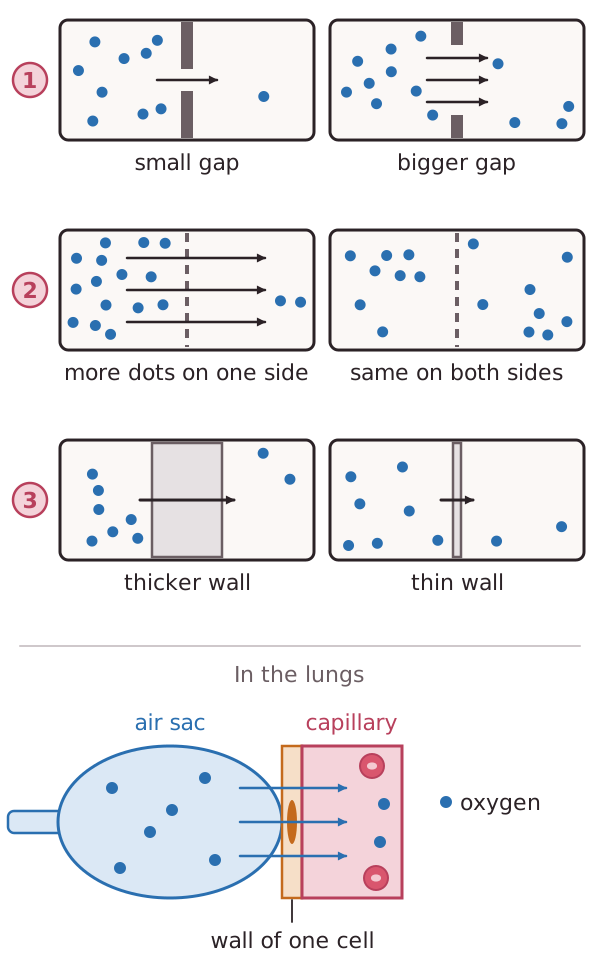
Diffusion is the net movement of particles from a region of higher concentration to a region of lower concentration. The particles move down a concentration gradient. Diffusion is passive, so the cell uses no energy. Three factors affect how fast it happens across an exchange surface.
- Surface area: the larger the surface area, the more particles can cross at the same time, so the rate of diffusion is faster. Folds and projections increase the surface area.
- Concentration gradient: the bigger the difference in concentration between the two sides, the steeper the gradient and the faster the rate. With a steep gradient, many more particles cross in one direction than the other.
- Diffusion distance: this is how far the particles have to travel. The thinner the exchange surface, the shorter the diffusion distance and the faster the rate.
Living things keep the rate high by building all three into their exchange surfaces. The small intestine is lined with villi. The folded surface gives a large surface area. The wall of a villus is one cell thick, which gives a short diffusion distance. Each villus has a network of blood capillaries, and the flowing blood carries absorbed food molecules away. This keeps the concentration of food molecules in the blood low, so the concentration gradient stays steep. Temperature also matters, because particles move faster when they are warmer.