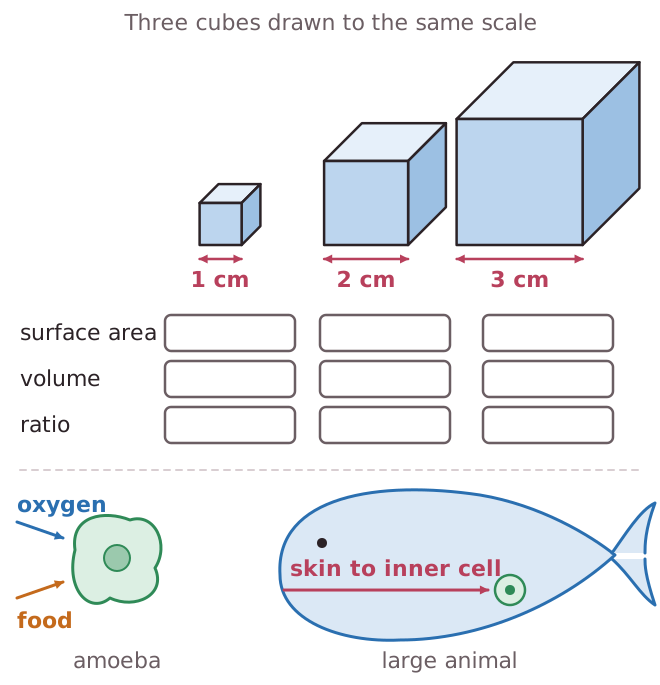
A single-celled organism such as an amoeba is very small. It has a large surface area to volume ratio and every part of the cell is close to the surface. Oxygen and food molecules can diffuse in across the cell membrane, and waste can diffuse out, fast enough to meet its needs. Diffusion alone is enough.
A multicellular organism is much bigger. Its volume grows faster than its surface area, so it has a small surface area to volume ratio. Many of its cells are deep inside the body, and the distance from the surface to those cells is much longer. Diffusion across the body surface would be far too slow to supply the inner cells. Large organisms therefore need exchange surfaces, such as the alveoli in the lungs, which have a large surface area and are thin. They also need a transport system, which in animals is the blood, to carry substances to and from the cells deep inside.
To calculate the ratio, divide the surface area by the volume. A cube has six faces. A cube with sides of 1 cm has a surface area of 6 and a volume of 1, so the ratio is 6 : 1. A cube with sides of 2 cm has a surface area of 6 × 4 = 24 and a volume of 2 × 2 × 2 = 8, so the ratio is 3 : 1. A cube with sides of 3 cm has a surface area of 6 × 9 = 54 and a volume of 27, so the ratio is 2 : 1. As the cube gets bigger, the ratio gets smaller.