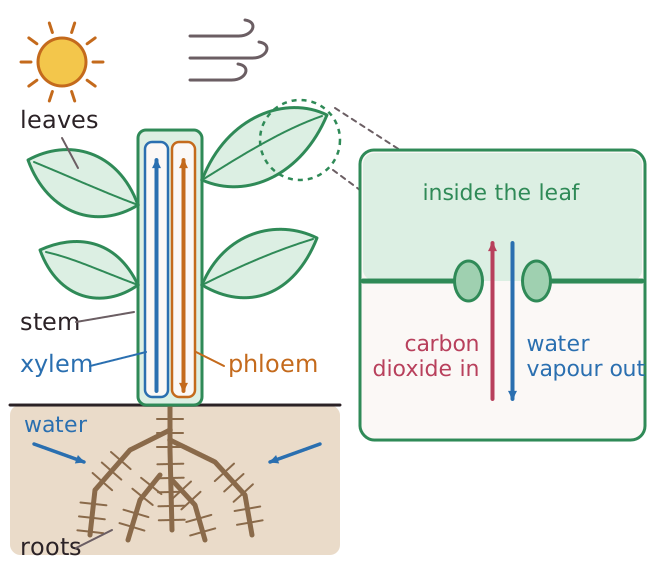
The roots, stem and leaves form a plant organ system for the transport of substances around the plant. Each part is adapted to its role.
Root hair cells have a long, thin extension that gives a large surface area. They take up water by osmosis, and mineral ions by active transport. Xylem tissue then carries the water and mineral ions up from the roots to the stem and leaves. It is made of hollow tubes strengthened by lignin, so water can flow through easily and the tubes do not collapse. Phloem tissue carries dissolved sugars from the leaves to the rest of the plant, for immediate use or for storage. This is called translocation.
Water moves up the xylem in the transpiration stream. Transpiration is the evaporation of water from the leaf, mostly through the stomata. Stomata open to let carbon dioxide in for photosynthesis, but water vapour escapes at the same time. Guard cells open and close the stomata to control gas exchange and water loss.
Transpiration is faster when the temperature is higher, when the air is less humid, when there is more air movement and when the light intensity is higher. Light makes the stomata open wider, and warm, dry, moving air carries water vapour away from the leaf quickly. The rate can be measured by the uptake of water: rate = volume of water taken up divided by time. For example, 2 cm3 in 10 minutes is a rate of 0.2 cm3 per minute.