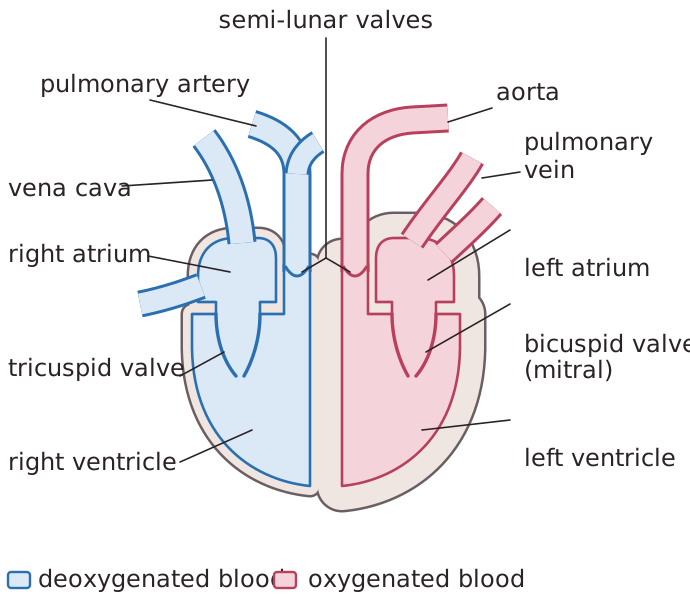
The human heart is made of left and right pumps. The walls are made of cardiac muscle and connective tissue. A thin membrane lines the heart.The left side of the heart pumps oxygenated blood from the lungs to the body. The right side of the heart pumps deoxygenated blood from the body to the lungs.Each side has a thin-walled atrium that is responsible for collecting blood. Blood is forced into the thicker walled ventricles through valves.The ventricles contract and pump blood out of the heart through the semilunar valves.Blood enters the right atrium through the venae cavae from the body. It is forced through the tricuspid valve into the right ventricle when the right atrium contracts. When the right ventricle contracts blood is forced through the pulmonary artery past the semi-lunar valves to the lungs.Blood enters the left atrium through the pulmonary vein from the lungs. It is forced through the bicuspid(mitral) valve into the left ventricle when the left atrium contracts. When the left ventricle contracts blood is forced through the aorta past the semi-lunar valves to the body.