When carbon dioxide diffuses out of respiring tissue, 5% of the CO2 dissolves in the plasma and about 10-20% binds to the amino group of the N-terminal amino acid of haemoglobin polypeptide chains. This is known as carbaminohaemoglobin.75-85% of the carbon dioxide that diffuses out of respiring tissue into the blood plasma diffuses into red blood cells down a concentration gradientCarbon dioxide reacts with water to form carbonic acid.H2O + CO2 → H2CO3 This dissociates into hydrogen ions and hydrogen carbonate ions.H2CO3 ⇌ H+ + HCO3- The reversible reaction is catalysed by the enzyme carbonic anhydrase in red blood cells.The negatively charged hydrogencarbonate ions move out of the cytoplasm down their concentration gradient and chloride ions move into the red blood cell to maintain the electrical balance of the cell. This is known as the chloride shift.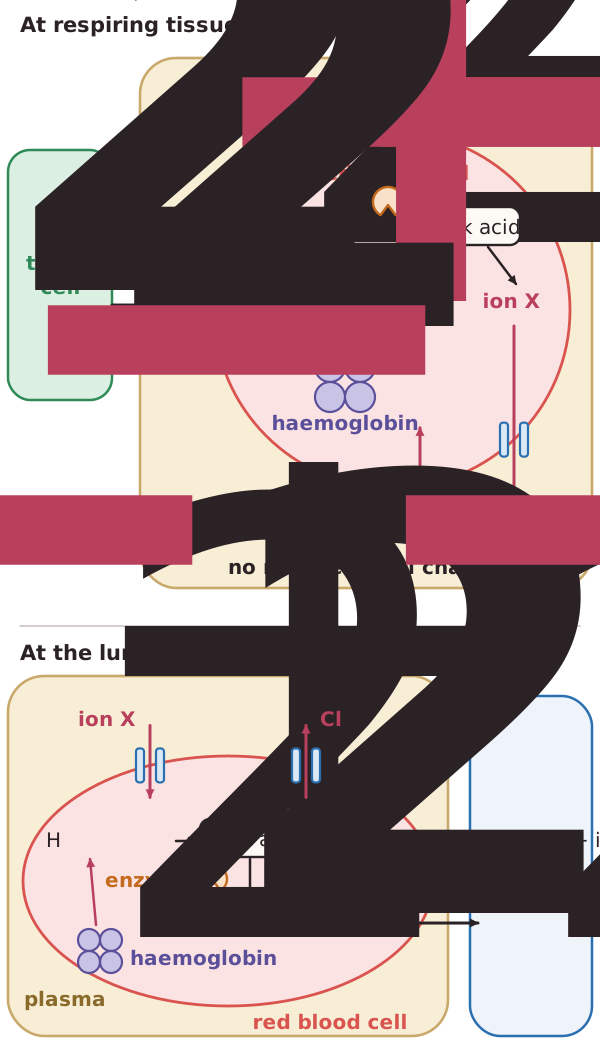 When the blood reaches the lungs the carbonic anhydrase catalyses the reverse reaction.Hydrogencarbonate ions diffuse back into the red blood cells and react with hydrogen ions to form carbon dioxide and water.Chloride ions diffuse out of the red blood cell down their concentration gradient to maintain the electrical balance.