 BRAINCAKE
Fetal Haemoglobin
A fetus cannot breathe air; it obtains oxygen from its mother's blood at the placenta. The maternal and fetal blood do not mix; oxygen diffuses from the mother's blood into the fetal blood across the placenta.
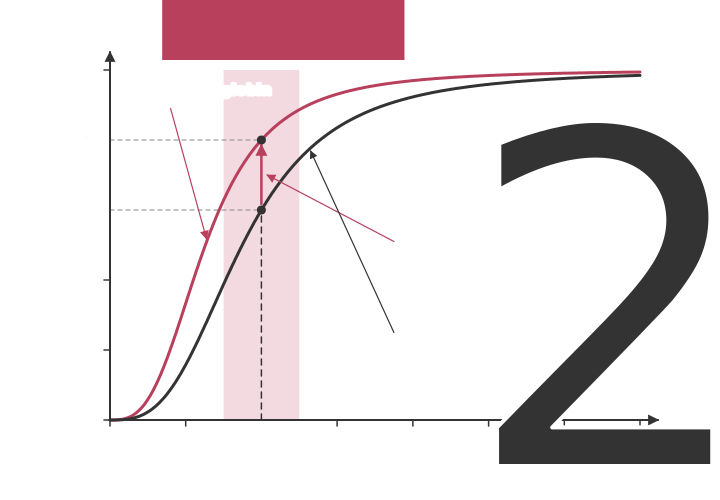
By the time maternal blood reaches the placenta, it has already given up some of its oxygen, so the pO2 at the placenta is fairly low. If the fetus had the same haemoglobin as its mother, its haemoglobin could not become well saturated there.
The fetus therefore has fetal haemoglobin, which has a higher affinity for oxygen than adult haemoglobin. Its oxygen dissociation curve is to the left of the adult curve: at any pO2, fetal haemoglobin is more saturated.
Sign in free to see the rest of this lesson, the R.E.C.I.P.E. recall steps and the quiz
BrainCake is free. Make an account in seconds and pick up where this page stops.
Key terms in this lesson
- haemoglobin
- The iron-containing, globular protein in red blood cells that binds reversibly to oxygen for transport around the body.
More in Transport in Animals
- Haemoglobin
- Oxygen Loading and Unloading
- The Oxygen Dissociation Curve
- Partial Pressure of Oxygen
- The Bohr Effect
- Transport of Carbon Dioxide
- Carbonic Anhydrase
- Haemoglobinic Acid
All 32 lessons in Transport in Animals · All OCR AS-level Biology topics