Haemoglobin picks up oxygen in one place and releases it in another. The amount of oxygen it holds depends mainly on the partial pressure of oxygen (pO2) around it.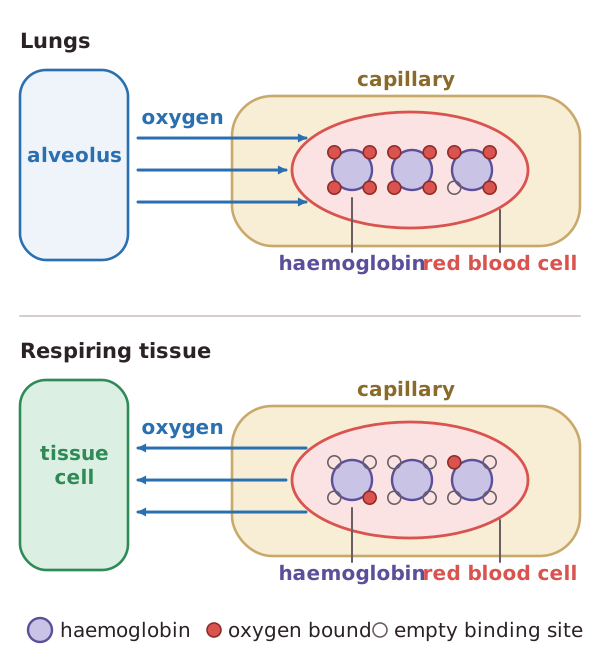 Loading (association) in the lungs: in the alveoli, pO2 is high. Oxygen diffuses from the alveoli into the blood plasma and then into the red blood cells, where it combines with haemoglobin to form oxyhaemoglobin. Haemoglobin has a high affinity for oxygen at high pO2, so it becomes almost fully saturated.Because oxygen is bound to haemoglobin, the concentration of free (dissolved) oxygen in the red blood cell stays low. This maintains a steep concentration gradient, so oxygen keeps diffusing in from the alveoli.Unloading (dissociation) in respiring tissues: cells use oxygen in aerobic respiration, so pO2 in the tissues is low. At low pO2, haemoglobin has a lower affinity for oxygen, so oxyhaemoglobin dissociates and releases oxygen. The oxygen diffuses out of the red blood cell, through the capillary wall and into the cells.The more active a tissue is, the lower its pO2, and the more oxygen haemoglobin unloads there. This matches oxygen supply to demand.Worked example: blood leaving the lungs is 98% saturated. Blood leaving resting muscle is 75% saturated, so 98 − 75 = 23% of the maximum oxygen was unloaded. In exercising muscle, blood leaves 25% saturated, so 98 − 25 = 73% was unloaded, more than three times as much.