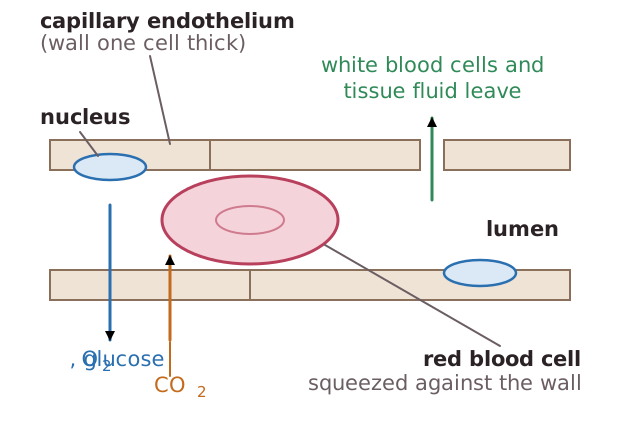
Capillaries exchange metabolic materials such as oxygen, carbon dioxide and glucose between the blood and cells of the body.Their walls consist mostly of the endothelium layer lining the blood vessels making them extremely thin for rapid diffusion.There are numerous capillaries and they are highly branched, providing a large surface area for exchange.They have a narrow diameter and spread through tissue which means no cell is far from a capillary. Their lumen is narrow so red blood cells are squeezed flat against the side of a capillary, which reduces the diffusion distance to the cells.There are spaces between the lining cells that allow white blood cells to escape.
Capillaries
Read the text
Read the text and highlight anything you think is important. When you go on, the text is hidden and you answer from memory.
Specification: OCR Biology A (H020), AS-level, 3.1.2 Transport in animals. Topic: Transport in Animals.
Key terms in this lesson
- diffusion
- The net movement of molecules or ions from a region of higher concentration to a region of lower concentration, down a concentration gradient.
More in Transport in Animals
- Blood Vessels
- Arteries
- Arterioles
- Veins and Venules
- Tissue Fluid
- Return of Tissue Fluid to Blood
- Chloride Shift
- Human Heart
All 32 lessons in Transport in Animals · All OCR AS-level Biology topics