 BRAINCAKE
Membrane Proteins
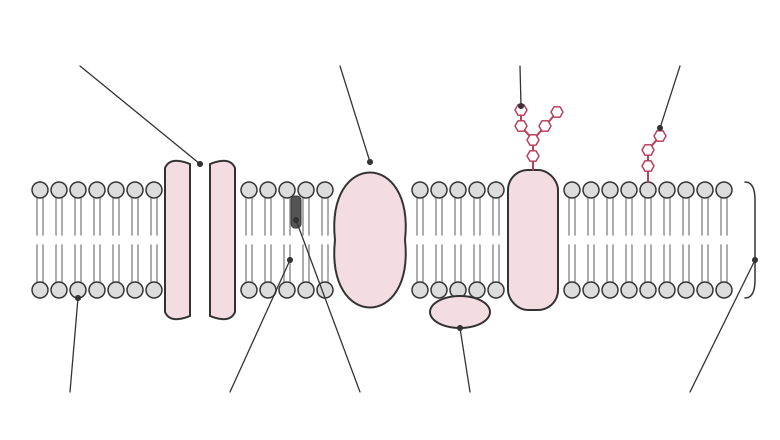
Many proteins are embedded in the phospholipid bilayer.
Channel proteins span the bilayer and form hydrophilic pores which are water-filled tubes to allow the diffusion of ions across the membrane.
Carrier proteins also span the bilayer. They bind to ions such as sodium and potassium ions and molecules such as glucose and amino-acids and change shape to allow these substances to diffuse across the membrane. The change in shape may be caused by the binding of ATP to the carrier protein. When this occurs it is known as active transport because it requires energy in the form of ATP.
Sign in free to see the rest of this lesson, the R.E.C.I.P.E. recall steps and the quiz
BrainCake is free. Make an account in seconds and pick up where this page stops.
Key terms in this lesson
- ATP
- Adenosine triphosphate, a nucleotide that acts as the immediate energy source of a cell, releasing energy when hydrolysed to ADP and inorganic phosphate.
- phospholipid bilayer
- Two layers of phospholipid molecules arranged with hydrophilic heads facing outwards and hydrophobic tails facing inwards, forming the basic structure of cell membranes.
- active transport
- The movement of molecules or ions across a membrane, often against their concentration gradient, using ATP and carrier proteins.
More in Plasma Membrane
- Membrane Structure
- Fluid Mosaic Model
- Glycoproteins
- Glycolipids
- Extrinsic Proteins
- Cholesterol
- Sites of Chemical Reactions
- Effect of Temperature
All 18 lessons in Plasma Membrane · All OCR AS-level Biology topics