 BRAINCAKE
Fluid Mosaic Model
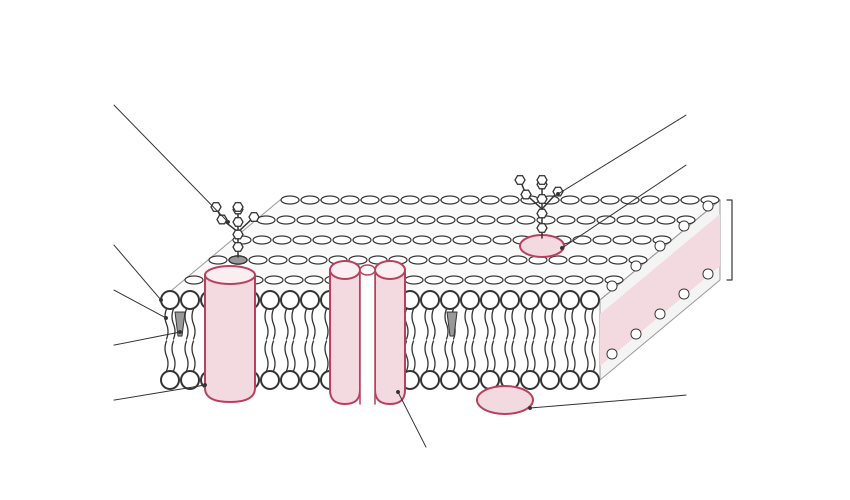
The fluid mosaic model, proposed by Singer and Nicolson in 1972, describes the structure of all cell membranes.
It is fluid because the phospholipids and many of the proteins can move sideways within the bilayer, so the membrane is flexible and constantly changing, rather than a fixed sheet.
It is a mosaic because the proteins are scattered through the bilayer in an irregular pattern, like tiles in a mosaic, when seen from above.
Sign in free to see the rest of this lesson, the R.E.C.I.P.E. recall steps and the quiz
BrainCake is free. Make an account in seconds and pick up where this page stops.
Key terms in this lesson
- cholesterol
- A steroid lipid found in cell membranes, mainly of animal cells, that regulates their fluidity and is a precursor of steroid hormones.
More in Eukaryotic Cells
- Ultrastructure
- Membranes
- Phospholipid Bilayer
- Membrane Proteins
- Eukaryotic Cells
- Protoplasm
- The Nucleus
- Mitochondria
All 30 lessons in Eukaryotic Cells · All Edexcel AS-level Biology topics