 BRAINCAKE
Evidence for Semi-Conservative DNA Replication
When Watson and Crick described DNA, three ways of copying it were possible:
• conservative: the original molecule stays intact and a completely new molecule is made
• semi-conservative: each new molecule has one original strand and one new strand
• dispersive: each strand is a mixture of old and new sections
Meselson and Stahl (1958) tested these. They grew the bacterium E. coli for many generations in a medium containing the heavy isotope nitrogen-15 (15N), so all its DNA bases contained heavy nitrogen. The bacteria were then moved to a medium containing the normal light isotope 14N. Samples were taken after each generation, the DNA was extracted and separated by density using centrifugation in caesium chloride solution. Heavier DNA settles lower in the tube.
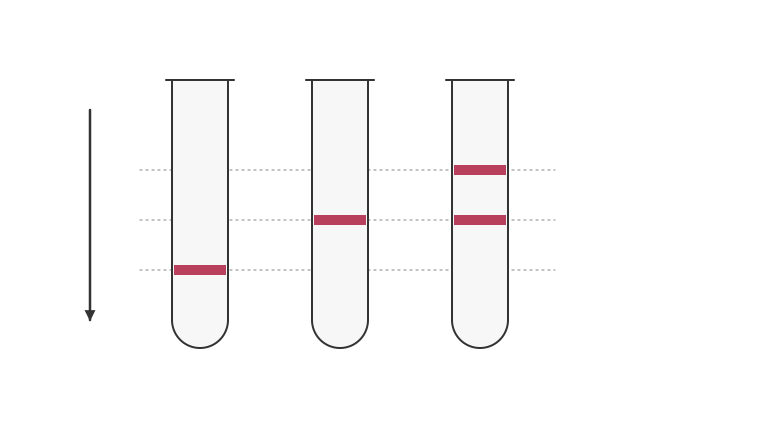
Sign in free to see the rest of this lesson, the R.E.C.I.P.E. recall steps and the quiz
BrainCake is free. Make an account in seconds and pick up where this page stops.
Key terms in this lesson
- centrifugation
- A technique that separates components of a mixture by spinning them at high speed, so denser material moves further from the axis.
More in DNA, Genes and Protein Synthesis
- ATP
- Nucleic Acids
- Phosphodiester Bonds
- Complementary Base Pairing
- DNA Replication
- The Genetic Code
- Types of RNA
- mRNA
All 20 lessons in DNA, Genes and Protein Synthesis · All Edexcel AS-level Biology topics