Nucleotides are the monomers that make up the nucleic acids DNA and RNA. Every nucleotide has three parts:• a phosphate group
• a pentose sugar (a five-carbon sugar)
• a nitrogenous base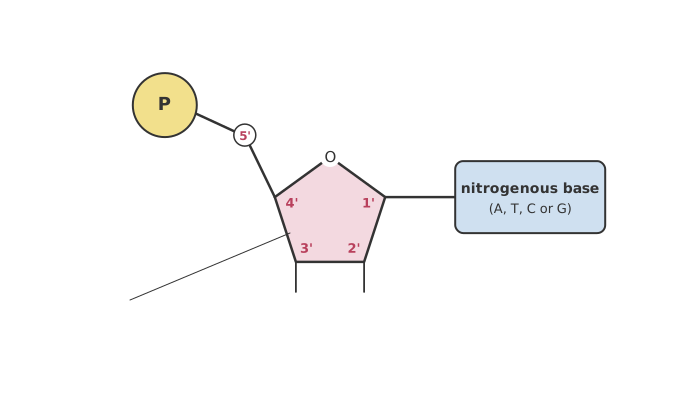
• pyrimidines, cytosine (C), thymine (T) and uracil (U), which have a single ringDNA contains A, T, C and G. RNA contains A, U, C and G, so uracil replaces thymine in RNA.The three parts are joined by condensation reactions, each releasing a molecule of water. The base is attached to carbon 1 of the sugar and the phosphate group is attached to carbon 5.Because there are four possible bases in each type of nucleic acid, there are four different DNA nucleotides and four different RNA nucleotides. The order of these nucleotides is what stores genetic information.
• a pentose sugar (a five-carbon sugar)
• a nitrogenous base
• pyrimidines, cytosine (C), thymine (T) and uracil (U), which have a single ringDNA contains A, T, C and G. RNA contains A, U, C and G, so uracil replaces thymine in RNA.The three parts are joined by condensation reactions, each releasing a molecule of water. The base is attached to carbon 1 of the sugar and the phosphate group is attached to carbon 5.Because there are four possible bases in each type of nucleic acid, there are four different DNA nucleotides and four different RNA nucleotides. The order of these nucleotides is what stores genetic information.