The nucleic acids, DNA and RNA, are polymers of nucleotides, so they are called polynucleotides. In each strand the nucleotides are linked into a sugar-phosphate backbone, with the bases sticking out to one side. The sequence of bases carries genetic information.DNA (deoxyribonucleic acid):
• is made of two polynucleotide strands wound around each other to form a double helix
• the two strands run in opposite directions, so they are antiparallel
• the bases point inwards and pair across the middle, holding the strands together
• contains deoxyribose and the bases A, T, C and G
• is very long and stable, so it is well suited to storing genetic information
• is found in the nucleus of eukaryotic cells (and in mitochondria and chloroplasts)RNA (ribonucleic acid):
• is usually a single polynucleotide strand
• contains ribose and the bases A, U, C and G
• is much shorter than DNA
• is involved in using genetic information to make proteins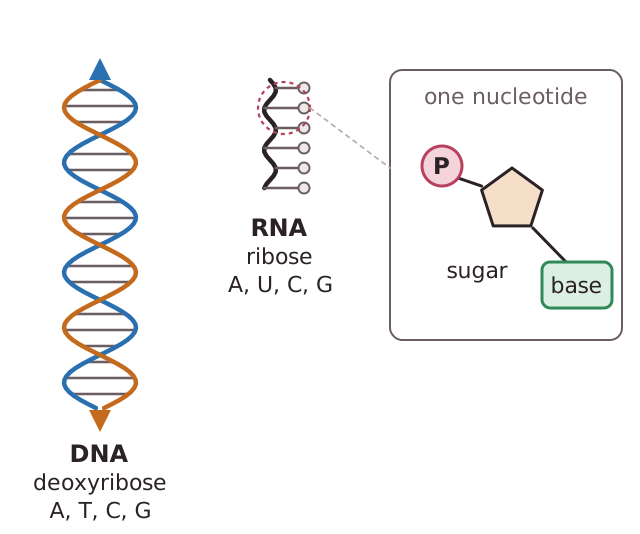 The double helix structure also protects the bases, which are on the inside of the molecule, from chemical damage.Worked example: a nucleic acid is found to contain ribose and uracil. Both are found only in RNA, so the molecule is RNA.
• is made of two polynucleotide strands wound around each other to form a double helix
• the two strands run in opposite directions, so they are antiparallel
• the bases point inwards and pair across the middle, holding the strands together
• contains deoxyribose and the bases A, T, C and G
• is very long and stable, so it is well suited to storing genetic information
• is found in the nucleus of eukaryotic cells (and in mitochondria and chloroplasts)RNA (ribonucleic acid):
• is usually a single polynucleotide strand
• contains ribose and the bases A, U, C and G
• is much shorter than DNA
• is involved in using genetic information to make proteins
The double helix structure also protects the bases, which are on the inside of the molecule, from chemical damage.Worked example: a nucleic acid is found to contain ribose and uracil. Both are found only in RNA, so the molecule is RNA.