Myoglobin is an oxygen-binding protein found in muscle cells, particularly in skeletal and heart muscle. It gives red muscle its dark colour.Its structure differs from haemoglobin:• it is a single polypeptide chain with a tertiary structure, not a quaternary structure
• it has one haem group, so each molecule binds only one oxygen molecule
• because there is only one binding site, there is no cooperative bindingMyoglobin has a much higher affinity for oxygen than haemoglobin. Its dissociation curve is:• far to the left of the haemoglobin curve
• hyperbolic (a steep rise then levelling off), not sigmoidThis means myoglobin stays almost fully saturated even at quite low pO2. It is not an oxygen transporter. Instead it acts as an oxygen store in the muscle:• at normal tissue pO2, oxygen released by haemoglobin is picked up by myoglobin
• myoglobin releases its oxygen only when pO2 becomes very low, for example during intense exercise when the blood supply cannot keep up
• this delays the onset of anaerobic respiration and lactate build-upWorked example: at 2 kPa, haemoglobin is about 25% saturated while myoglobin is still about 90% saturated. Myoglobin will not give up most of its oxygen until pO2 falls well below this.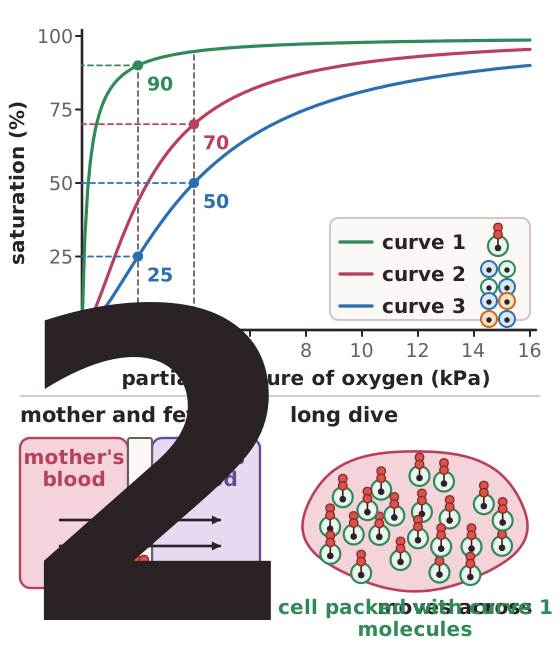 Diving mammals such as seals and whales have very high concentrations of myoglobin in their muscles, giving a large oxygen store for long dives.
• it has one haem group, so each molecule binds only one oxygen molecule
• because there is only one binding site, there is no cooperative bindingMyoglobin has a much higher affinity for oxygen than haemoglobin. Its dissociation curve is:• far to the left of the haemoglobin curve
• hyperbolic (a steep rise then levelling off), not sigmoidThis means myoglobin stays almost fully saturated even at quite low pO2. It is not an oxygen transporter. Instead it acts as an oxygen store in the muscle:• at normal tissue pO2, oxygen released by haemoglobin is picked up by myoglobin
• myoglobin releases its oxygen only when pO2 becomes very low, for example during intense exercise when the blood supply cannot keep up
• this delays the onset of anaerobic respiration and lactate build-upWorked example: at 2 kPa, haemoglobin is about 25% saturated while myoglobin is still about 90% saturated. Myoglobin will not give up most of its oxygen until pO2 falls well below this.
Diving mammals such as seals and whales have very high concentrations of myoglobin in their muscles, giving a large oxygen store for long dives.