 BRAINCAKE
Blood Vessels
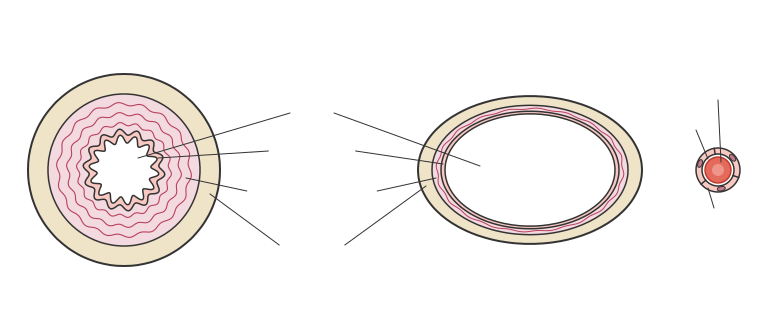
Blood is carried around the body in a closed system of vessels. Blood leaves the heart in arteries, which branch into smaller arterioles. Arterioles lead into networks of tiny capillaries, where substances are exchanged with the tissues. Capillaries join to form venules, which join to form veins that return blood to the heart.
The space in the middle of a vessel through which blood flows is the lumen. Arteries, arterioles, venules and veins all have walls made of three layers:
Inner layer (tunica intima). A single layer of flattened cells called the endothelium. It is very smooth, which reduces friction with the flowing blood.
Sign in free to see the rest of this lesson, the R.E.C.I.P.E. recall steps and the quiz
BrainCake is free. Make an account in seconds and pick up where this page stops.
More in Circulatory Systems
- Myoglobin
- Transport of Carbon Dioxide
- Blood Clotting
- The Blood Clotting Cascade
- Arteries
- Arterioles
- Capillaries
- Veins and venules
All 33 lessons in Circulatory Systems · All Edexcel AS-level Biology topics