A fetus gets its oxygen from its mother's blood at the placenta. The two blood supplies do not mix; oxygen must diffuse from the mother's haemoglobin, across the placenta, into the fetal blood. The pO2 in the placenta is quite low, so the fetus needs haemoglobin that can pick up oxygen there.Fetal haemoglobin (HbF) has a higher affinity for oxygen than adult haemoglobin (HbA). It is made of two α chains and two γ (gamma) chains instead of two β (beta) chains. This slight difference in structure means it binds oxygen more readily.As a result, the fetal oxygen dissociation curve lies to the left of the adult curve: at any given pO2, fetal haemoglobin is more saturated with oxygen than adult haemoglobin.At the low pO2 of the placenta:• maternal haemoglobin is on the steep part of its curve, so it unloads oxygen
• fetal haemoglobin, with its higher affinity, loads this oxygen
• oxygen therefore moves from mother to fetusThe Bohr effect helps too: carbon dioxide from fetal blood diffuses into maternal blood, shifting the maternal curve to the right and making it release even more oxygen.Worked example: at a placental pO2 of 4 kPa, maternal haemoglobin might be 50% saturated while fetal haemoglobin is 70% saturated, so oxygen passes to the fetus.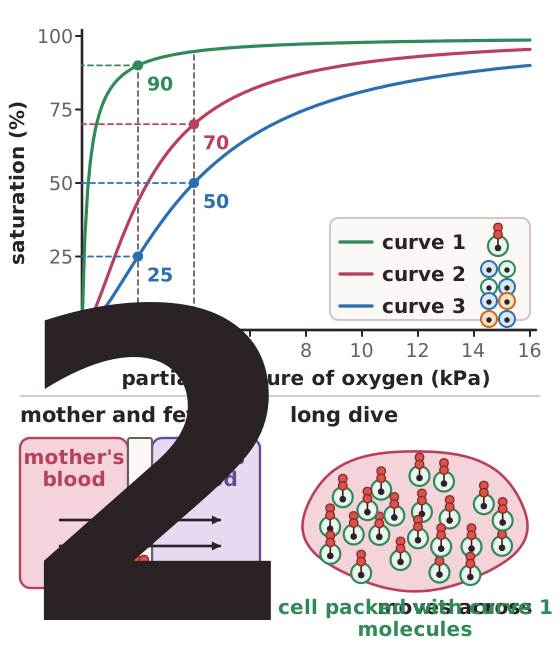 After birth, the baby breathes air and can load oxygen in its own lungs, so fetal haemoglobin is gradually replaced by adult haemoglobin over the first months of life. Adult haemoglobin unloads oxygen more easily in the tissues.
• fetal haemoglobin, with its higher affinity, loads this oxygen
• oxygen therefore moves from mother to fetusThe Bohr effect helps too: carbon dioxide from fetal blood diffuses into maternal blood, shifting the maternal curve to the right and making it release even more oxygen.Worked example: at a placental pO2 of 4 kPa, maternal haemoglobin might be 50% saturated while fetal haemoglobin is 70% saturated, so oxygen passes to the fetus.
After birth, the baby breathes air and can load oxygen in its own lungs, so fetal haemoglobin is gradually replaced by adult haemoglobin over the first months of life. Adult haemoglobin unloads oxygen more easily in the tissues.