Skip to content

Water in Plant Transport Systems

Plants move water from the roots to the leaves through xylem vessels: long, hollow tubes made of dead cells with no end walls, whose walls are strengthened with lignin. The upward flow of water in the xylem is the transpiration stream.Cohesion–tension theory. Water evaporates from the surfaces of mesophyll cells into the air spaces of the leaf, and water vapour diffuses out through the stomata. This loss is transpiration. Water moves into the mesophyll cells from the xylem to replace it.
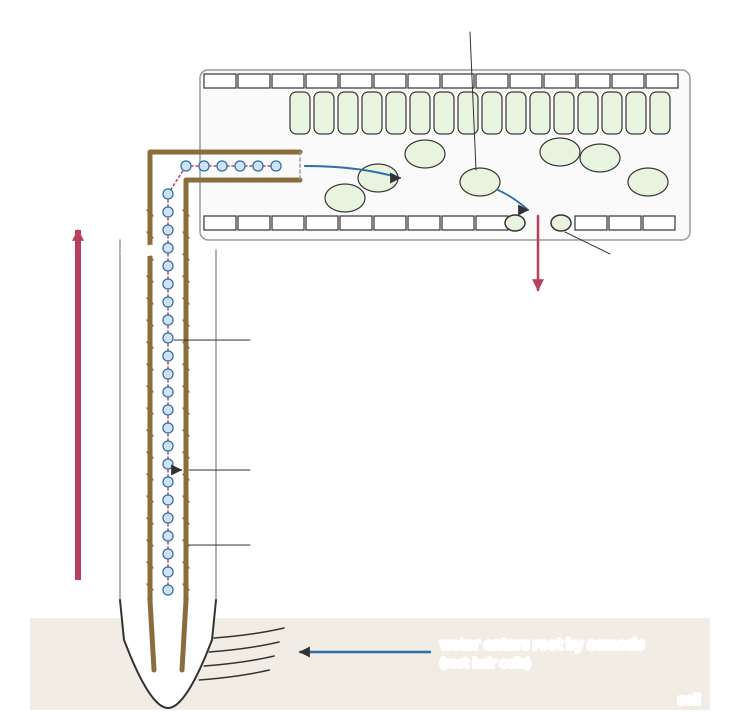
Water molecules are held together by hydrogen bonds (cohesion), so the column of water in each xylem vessel behaves like a continuous thread. As water is pulled out at the top, the whole column is pulled up, putting the water under tension (negative pressure). The lignified walls stop the vessels collapsing inward.Water molecules are also attracted to the walls of the xylem (adhesion), which helps the water to rise and stops the column breaking. In very narrow tubes, adhesion and cohesion together cause capillarity.Root pressure gives a small extra push from below, as active transport of ions into the xylem in the root lowers its water potential and water follows by osmosis.Water also dissolves the mineral ions carried in the xylem, and sucrose carried in the phloem.Evidence: when a xylem vessel is cut, air is drawn in rather than water leaking out, and tree trunks shrink slightly in diameter during the day when transpiration is fastest. Both show that the water is under tension.

Read the text

Read the text and highlight anything you think is important. When you go on, the text is hidden and you answer from memory.

Specification: Edexcel Biology B (8BI0), AS-level, 1.7 Water. Topic: Chemistry for Life.

Key terms in this lesson

buffer solution
A solution that resists changes in pH when small amounts of acid or alkali are added.

More in Chemistry for Life

All 10 lessons in Chemistry for Life · All Edexcel AS-level Biology topics