Liquid water is almost incompressible: squeezing it hardly reduces its volume. Organisms use this property to support themselves and to move, in the same way that a hydraulic ram uses oil.Turgor in plants. When a plant cell takes in water by osmosis, the vacuole swells and pushes the cytoplasm against the cell wall. The pressure of the cell contents on the wall is turgor pressure, and the cell is turgid. Turgid cells pressing against each other support non-woody plants such as seedlings and leaves. If the plant loses more water than it takes in, cells become flaccid and the plant wilts.Stomata. The opening of stomata is a hydraulic mechanism. When guard cells take up water and become turgid, their thick inner walls cause them to curve apart and open the pore. When they lose water, they straighten and the pore closes.Hydrostatic skeletons. Earthworms have a fluid-filled body cavity surrounded by two layers of muscle. Because the fluid cannot be compressed, contracting the circular muscles makes a segment long and thin, and contracting the longitudinal muscles makes it short and fat. The two layers are antagonistic, and waves of contraction move the worm forward.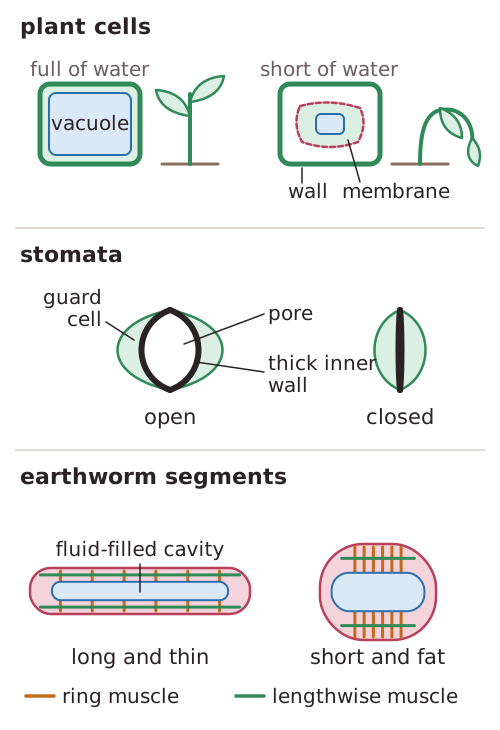 Other examples. Spiders extend their legs by pumping fluid into them, and some flowers and leaves (for example the leaflets of Mimosa) move by changing turgor in particular cells.Worked idea: an earthworm segment keeps the same volume. If circular muscles contract and halve its width, its length must increase to keep the fluid volume constant.