Much of Earth's life lives in water: oceans, rivers, lakes and ponds. The properties of water make these stable places to live.Stable temperature. Water has a high specific heat capacity, so large bodies of water change temperature slowly between day and night and between seasons. Aquatic organisms experience far smaller temperature changes than organisms on land, so their enzymes work at fairly constant rates.Ice floats. Water is densest at 4 °C. As it cools further, hydrogen bonds hold the molecules in an open lattice, so ice is less dense than liquid water and forms on the surface. The layer of ice insulates the water beneath, which stays liquid, so fish and other organisms survive the winter.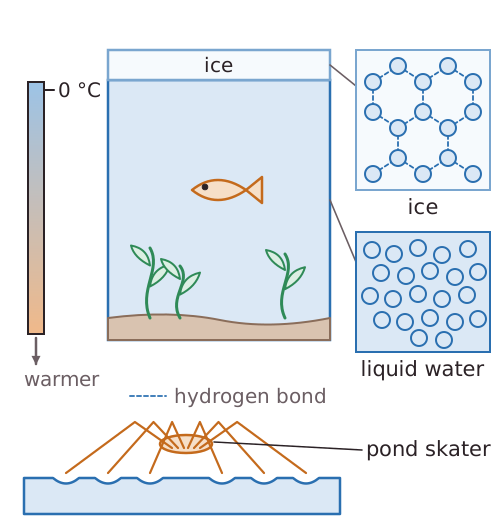 Surface tension. Cohesion between water molecules produces a high surface tension. Small animals such as pond skaters can move on the surface film, and some larvae hang from it.Transparency. Water lets light through, so aquatic plants and algae can photosynthesise below the surface.Support. Water is dense enough to buoy organisms up. Large animals such as whales can grow bigger in water than on land, and many aquatic plants need little supporting tissue.Dissolved gases. Oxygen and carbon dioxide dissolve in water, supplying aquatic organisms for respiration and photosynthesis. Less oxygen dissolves as water gets warmer: at 20 °C water holds about 9 mg dm−3 of oxygen, while at 5 °C it holds about 13 mg dm−3. Warm water can therefore limit active animals such as trout.